
VPN ban waves occupy a strange place in gaming folklore: everyone has heard of them, half the community swears “VPNs get you banned,” the other half swears they never do — and almost nobody can cite what actually happened, when, or why. That vacuum breeds bad decisions on both sides. Players abandon legitimate protection out of unfounded fear, while others walk confidently into genuine enforcement actions that a little history would have warned them about.
So let’s fill the vacuum with the record. Cure VPN sits at the center of this question every day — our users game, stream, and travel across the exact platforms that have spent a decade tightening their VPN posture — and we’d rather you understand the documented history than inherit the folklore. In this article, we trace the real ban waves and crackdowns across game publishers and content platforms from 2014 to today: what each publisher actually enforced, what triggered it, who got caught, and the pattern that separates the players who were never at risk from the ones who always were. One promise up front: this is history and honest guidance for staying within the rules, not a manual for breaking them. That distinction, as the record shows, is precisely the line publishers have always drawn too.
Do VPNs Get You Banned?
A decade of documented VPN ban waves shows a consistent pattern: publishers have almost never banned players simply for connecting through a VPN. Instead, every major enforcement action targeted a behavior the VPN enabled — regional pricing abuse (Steam, 2014–2015), geo-restriction evasion (Netflix’s 2016 proxy crackdown), cross-region play and cheating (PUBG’s 2017–2018 ban waves), matchmaking manipulation (“VPN lobbies” in Warzone, 2020–2021), and ban evasion itself. Legitimate uses — privacy, DDoS protection, ISP-throttling relief, stable routing — have never been the target, though users on low-quality VPNs occasionally suffer collateral flags from sharing IP ranges with abusers. The rule the history teaches: the VPN was never the crime; what people did with it was.
That’s the verdict the record supports. The evidence — era by era, publisher by publisher — follows.
What a Ban Wave Is – and How VPNs Get Entangled
Definition: A ban wave is a mass enforcement action in which a publisher suspends or permanently bans a large batch of accounts simultaneously, typically after weeks of silently collecting evidence. Publishers prefer waves to instant bans because delayed, batched enforcement makes it far harder for cheat developers and ToS violators to work out exactly what triggered detection.
VPNs enter this story through five distinct entanglement patterns, and keeping them separate is what makes the history legible:
- Enablement of ToS violations. The VPN itself is neutral, but it enables the violating behavior — buying games at another region’s prices, accessing region-locked content, or manipulating matchmaking. Enforcement targets the behavior; the VPN is the vehicle.
- Overlap with cheating infrastructure. Cheaters use VPNs (among many tools) to evade bans and mask identity. When anti-cheat waves sweep, VPN usage appears in the data — creating the correlation that folklore later misremembers as causation.
- Ban evasion. Returning to a game after a ban via new accounts and masked IPs is itself a violation everywhere, and publishers pursue it aggressively.
- Shared IP collateral. Hundreds of users share a commercial VPN server’s IP. When abusers poison that address’s reputation, legitimate users on the same range inherit flags, captchas, blocks, and occasionally erroneous suspensions.
- Policy ambiguity. Most publishers’ terms prohibit “misrepresenting your location” or “circumventing restrictions” without mentioning VPNs by name — leaving a gray zone that each era of enforcement progressively clarified.
Hold those five patterns in mind; every event in the timeline is one of them wearing a different costume.
The Documented Timeline, Era by Era
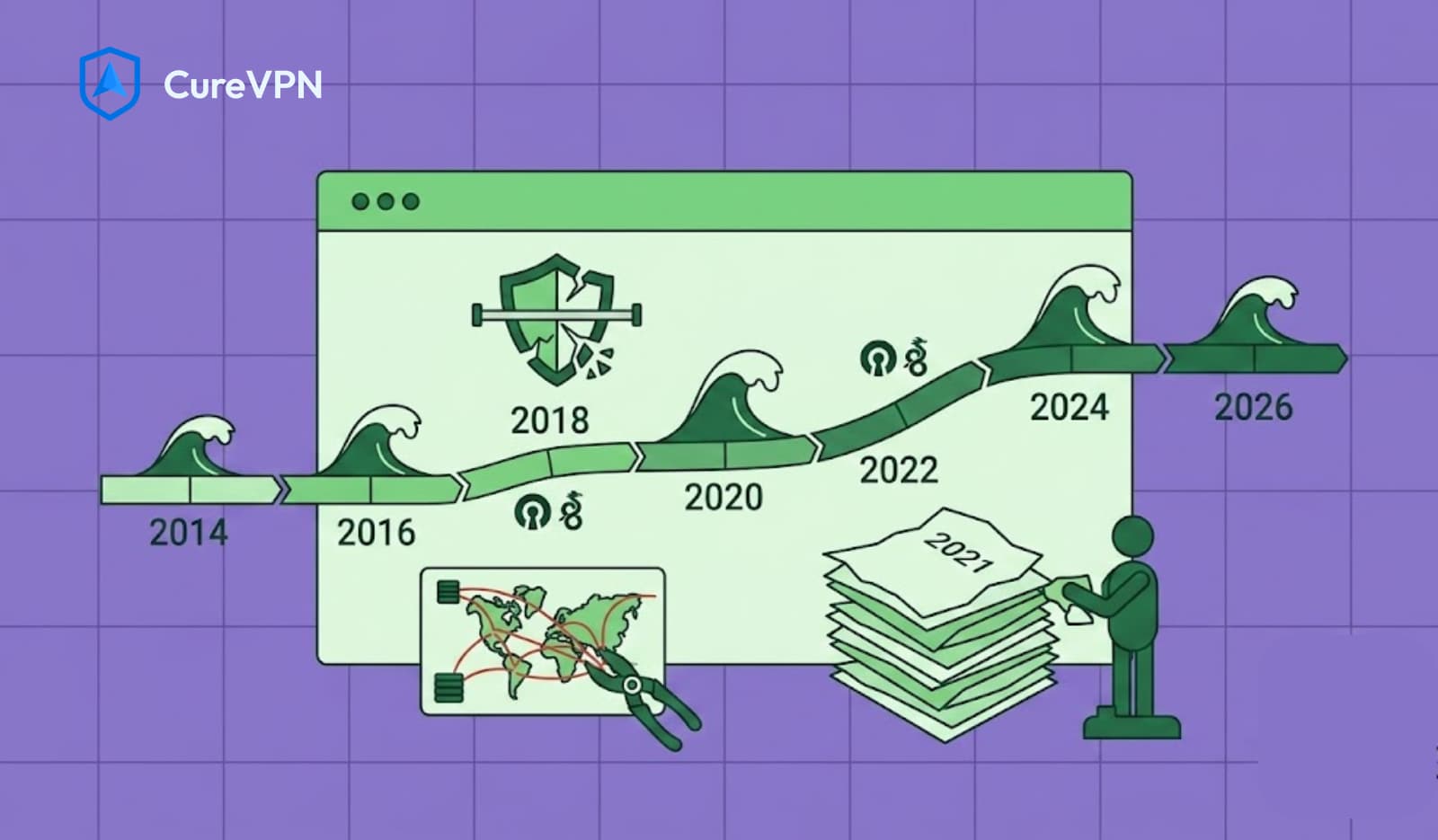
The decade breaks cleanly into six eras, each defined by what publishers decided to enforce:
| Era | Years | Defining Enforcement | Primary Pattern |
|---|---|---|---|
| 1 | 2014–2016 | Steam regional-pricing terminations | Enablement (pricing abuse) |
| 2 | 2016 | Netflix proxy crackdown | Enablement (geo-evasion) |
| 3 | 2017–2018 | PUBG mega-waves, region locks | Cheating overlap + cross-region |
| 4 | 2019–2021 | Warzone “VPN lobbies,” Ricochet launch | Matchmaking manipulation |
| 5 | 2021–2023 | Kernel anti-cheat era, residential-IP blocking | Ban evasion + collateral |
| 6 | 2024–2026 | Normalized, behavior-focused enforcement | Détente with teeth |
Era 1 (2014-2016): The Regional Pricing Reckoning
The modern history opens not with cheating but with money. Valve prices Steam games regionally — a launch costing $60 in the US might cost a fraction of that in other markets — and by 2014, using a VPN to buy or activate games from cheaper regions had become an open secret. Valve’s response set the template every publisher would follow: it enforced against the transaction, not the tool. Documented actions in this era included revoking games activated through region-shifted gift and key purchases and, in repeat cases, restricting or terminating the accounts involved, with Valve’s Steam Subscriber Agreement explicitly prohibiting the use of VPNs and proxies to disguise your region for purchasing.
Blizzard ran a quieter parallel track through the same years. Its long-standing terms prohibited IP manipulation, and players in restricted regions connecting through VPNs — along with VPN-using bot operations swept up in Blizzard’s periodic bot ban waves across World of Warcraft and Diablo — learned that “the ToS didn’t say VPN specifically” was not a defense. The era’s lesson crystallized early: publishers could distinguish a VPN used for privacy from a VPN used to reach into another region’s wallet, and only one of those drew fire.
Era 2 (2016): Streaming Joins the War – the Netflix Crackdown
January 2016 is the single most cited date in VPN blocking history. Days after expanding to 190 countries, Netflix publicly announced it would begin blocking proxies and VPNs used to view content outside licensed regions — and unlike the quiet gaming enforcement before it, this crackdown was loud, official, and technical. Netflix began blacklisting the datacenter IP ranges commercial VPNs relied on, and within months, the “Netflix proxy error” screen became the most famous error message in the VPN world.
The significance for this history is structural. Netflix normalized IP-range blocking at scale — not banning user accounts, but rendering VPN exit points useless — and the rest of the content industry followed: BBC iPlayer tightened its VPN detection across 2015–2018, and sports and streaming platforms worldwide adopted the same playbook. Crucially, the streaming approach also demonstrated the collateral problem that would haunt gaming later: because platforms blocked ranges rather than behavior, every legitimate privacy user on a blacklisted server lost access alongside the geo-hoppers. Publishers had learned to fight VPN infrastructure itself, and that weapon never went back in the drawer.
Era 3 (2017-2018): PUBG and the Region-Lock Wars
PlayerUnknown’s Battlegrounds turned the simmer into a boil. The 2017 phenomenon shipped with a cheating crisis of historic scale, and its enforcement numbers remain the most staggering on record: BattlEye, PUBG’s anti-cheat partner, publicly reported banning millions of accounts — announcing over 13 million bans by mid-2018, with individual monthly waves reaching seven figures. Cross-region play sat at the center of the community storm, and VPNs sat at the center of cross-region play: players routed into other regions’ servers for perceived easier lobbies or to dodge regional matchmaking, while cheat operations used the same routes at industrial scale.
PUBG Corp’s responses across 2017–2018 — experiments with region locking, ping-based matchmaking restrictions, and relentless ban waves — made this the era when “VPN” and “ban wave” fused in gaming’s collective memory. The precision of what happened, though, matters for the record: the waves targeted cheat signatures and abusive patterns, with VPN routing appearing as a correlated behavior rather than a standalone offense. Players using VPNs for stable routing or DDoS protection were not the quarry — but they were now swimming in the same statistical water as the largest cheating population gaming had ever seen, and the folklore stopped distinguishing.
Era 4 (2019-2021): Warzone, “VPN Lobbies,” and Ricochet
Call of Duty: Warzone’s 2020 explosion created this history’s most specific VPN controversy: the “VPN lobby.” Warzone’s skill-based matchmaking sparked a cottage industry of routing tricks — connecting through VPN servers in low-population or off-peak regions in pursuit of easier lobbies — openly advertised by services and celebrated in YouTube thumbnails. Simultaneously, Warzone’s own cheating crisis dwarfed everything since PUBG, and Activision’s enforcement escalated accordingly: publicly announced ban waves removed hundreds of thousands of accounts across 2020–2021 (with single announcements covering tens of thousands at a time), culminating in the October 2021 launch of the Ricochet kernel-level anti-cheat.
The era’s documented enforcement drew the line this entire history keeps drawing. Activision’s public statements and security communications targeted cheating, ban evasion, and manipulation of matchmaking — and Ricochet’s arrival gave the publisher unprecedented visibility into repeat offenders regardless of IP tricks, making VPN-based ban evasion dramatically less effective. Meanwhile, ordinary VPN use for privacy or connection stability continued at massive scale without generating an enforcement wave of its own. Epic’s Fortnite ran a parallel storyline in the competitive scene, where region requirements for tournaments made VPN-based region misrepresentation a rule violation with documented competitive penalties — again, the misrepresentation, not the tool.
Era 5 (2021-2023): Kernel Anti-Cheat and the Residential IP Squeeze
Two escalations define this era, one on each side of the VPN wars.
On the gaming side, kernel-level anti-cheat became the norm rather than the exception — Riot’s Vanguard (guarding Valorant since 2020 and later League of Legends), Activision’s Ricochet, EA’s anticheat, and Battlestate’s aggressive Escape from Tarkov waves. Deep system visibility changed the ban-evasion equation permanently: publishers could increasingly recognize the machine and the behavior pattern, making an IP change through a VPN close to irrelevant for evading a serious ban. Notably, Riot’s posture toward VPNs settled into the industry’s emerging consensus — general play through a VPN tolerated, with enforcement reserved for smurfing operations, account-selling infrastructure, and regional manipulation in ranked ecosystems.
On the streaming side, Netflix escalated the 2016 playbook in 2021 by expanding blocks to residential IP ranges associated with VPN and proxy services — a move that famously produced collateral damage for ordinary users whose home ISPs shared flagged ranges, before refinements narrowed it. The escalation confirmed the collateral lesson at scale: when platforms fight VPN infrastructure, innocent users on shared or mislabeled ranges absorb the shrapnel. IP reputation — which ranges a VPN service provider maintains, how clean they stay, how quickly abuse gets evicted — quietly became the difference between a VPN that coexists with platforms and one that fights them.
Era 6 (2024-2026): The Current Détente
The present era is best described as a détente with teeth. The documented rules of engagement, as they stand across the industry today:
- Mere VPN connection is broadly tolerated across major publishers for ordinary play. A decade of enforcement produced no wave targeting privacy-motivated VPN use as such, and current policies continue targeting behaviors.
- Behavior enforcement is sharper than ever. Matchmaking manipulation, regional pricing abuse, tournament region misrepresentation, and ban evasion remain prohibited everywhere and are caught more reliably than at any point in this history, thanks to kernel anti-cheat, hardware identification, and behavioral analytics that see straight through IP changes.
- IP reputation does the day-to-day filtering. Rather than banning accounts, platforms increasingly apply friction — captchas, purchase blocks, streaming errors, matchmaking restrictions — to low-reputation VPN ranges, which means the quality of your VPN provider now determines your everyday experience more than any policy document does.
- Regional-pricing enforcement matured. Valve and other storefronts responded to a decade of abuse with structural fixes — currency and payment-method requirements, regional purchase restrictions — reducing the cat-and-mouse rather than escalating the bans.
The folklore, in short, is a decade out of date in both directions: the blanket fear (“any VPN means a ban”) was never the record, and the blanket confidence (“publishers can’t tell anyway”) died with kernel anti-cheat.
The Publisher Policy Map
The current landscape, condensed — always subject to each publisher’s live terms, which control over any summary:
| Publisher / Platform | VPN for Ordinary Play | What Gets Enforced | Documented History |
|---|---|---|---|
| Valve / Steam | Tolerated | Regional pricing/activation abuse, misrepresenting region for purchases | 2014–2015 terminations; structural pricing fixes since |
| Activision (CoD/Warzone) | Tolerated | Matchmaking manipulation, cheating, ban evasion | 2020–2021 mega-waves; Ricochet (2021) |
| Riot (Valorant/LoL) | Generally tolerated | Smurfing infrastructure, regional/ranked manipulation | Vanguard era enforcement (2020– ) |
| PUBG / Krafton | Tolerated | Cheating, cross-region abuse | 13M+ bans by 2018; region restrictions |
| Epic (Fortnite) | Tolerated in pubs | Tournament region misrepresentation | Competitive-rule penalties |
| Blizzard | Gray — ToS prohibits IP manipulation | Restricted-region access, botting | Longest-running quiet enforcement |
| Netflix & streaming | Account-safe, access-blocked | Geo-restriction evasion (blocked, not banned) | 2016 crackdown; 2021 residential squeeze |
Two readings of this table matter. First, the convergence: every publisher independently arrived at the same line — tool tolerated, behavior enforced. Second, the streaming distinction: content platforms historically block rather than ban, which is why no documented Netflix “account ban wave” for VPN use exists despite a decade of blocking.
Why Legitimate VPN Users Get Caught in Waves?
The history’s most unfair chapter deserves its own section, because it’s the one that affects readers doing nothing wrong. Legitimate users get flagged through three documented mechanisms:
- Shared IP reputation. You and several hundred strangers exit through the same VPN server. If some of those strangers ran account farms, evaded bans, or triggered fraud systems, the address’s reputation curdles — and every platform’s risk scoring treats you as partially guilty by association. This is the mechanism behind most “I got flagged and I swear I did nothing” stories, and it’s overwhelmingly a provider quality problem: budget and free VPNs with lax abuse enforcement accumulate poisoned ranges.
- Datacenter fingerprints. Commercial VPN traffic looks like datacenter traffic, and platforms apply extra scrutiny to datacenter ranges by default — more captchas, more friction, occasionally automated restrictions — regardless of your behavior.
- Mid-session region weirdness. Connecting from one country at breakfast and another at lunch resembles account-compromise patterns, and security systems respond accordingly with locks and verification challenges. It’s protective, not punitive — but it feels identical from the receiving end.
The mitigation is unglamorous and effective: use a reputable provider that polices abuse and maintains clean IP ranges, keep your exit region consistent with your actual play region, and prefer gaming-appropriate servers over exotic ones. That’s not a loophole; it’s just not looking like the people the systems were built to catch. Range hygiene is, frankly, where providers earn their subscription — it’s an operational discipline we treat as core infrastructure at Cure VPN, because a VPN that gets you captcha’d everywhere protects you into a worse experience.
The Pattern: What a Decade of Enforcement Actually Targets
Compress ten years of documented waves into one paragraph and the pattern is almost embarrassingly consistent. Publishers enforced, in every era, against exactly four things: taking money (regional pricing abuse), taking content (geo-restriction evasion), taking unfair matches (matchmaking and region manipulation, smurfing), and coming back after removal (ban evasion). Not one documented wave targeted privacy, DDoS protection, ISP-throttling relief, or stable routing — the uses that constitute the overwhelming majority of real VPN traffic. The tool appears throughout the history the way a car appears in traffic court: constantly present, never itself the charge.
That pattern is also the entire practical guidance, and it’s why this article can be honest without being a rulebook for mischief. Stay off those four behaviors and the decade of history says you were never the target. Step onto them and the same decade says the VPN won’t save you — and in the kernel anti-cheat era, it particularly won’t.
Expert Insights
Watching this history from inside a VPN provider adds a few readings the timeline alone doesn’t surface.
The folklore inverted the actual risk. For a decade, community wisdom warned that VPNs endanger your account while assuming your experience was fine. The record shows the opposite: account-level risk for legitimate users has been consistently near zero, while experience-level friction — captchas, blocks, flagged ranges, streaming errors — has been the real, growing tax, and it tracks provider quality almost perfectly. The practical question was never “will I get banned?” It was always “is my provider’s IP neighborhood clean enough that platforms leave me alone?”
Kernel anti-cheat quietly ended an argument. Before 2020, the ban-evasion debate had a technical dimension — publishers genuinely struggled to re-identify determined evaders, and IP masking mattered. Vanguard, Ricochet, and their peers closed that chapter: identification moved below the network layer, and the VPN’s role in evasion collapsed. One under-appreciated consequence benefits legitimate users directly: as publishers gained better tools for identifying actual offenders, their need to treat VPN traffic as a proxy signal declined — which is a meaningful reason the current era is a détente rather than an escalation.
Consistency reads as innocence. Across every platform’s risk systems, the pattern that keeps legitimate VPN users invisible is boring consistency: the same region, sensible hours, one account, behavior matching a human playing games. A real composite from our support work makes the point — a competitive player using VPN routing for DDoS protection worried for months about ban risk while a friend hopping regions nightly for “easier lobbies” mocked his caution; the cautious player has never seen so much as a captcha, while the region-hopper ate a matchmaking restriction exactly as the Warzone-era record predicts. The systems, it turns out, are reasonably good at telling protection from manipulation. Behave like the former and the decade of history is on your side.
Statistics & Data
The scale of the documented record, with sources worth citing:
- PUBG’s enforcement remains the historical high-water mark: BattlEye publicly reported surpassing 13 million PUBG bans by mid-2018, with individual monthly waves in the millions — the era that fused “ban wave” into gaming vocabulary. (Source: BattlEye public statements, PUBG Corp announcements.)
- Warzone’s waves were publicly itemized: Activision announced repeated mass actions across 2020–2021 — including single waves covering tens of thousands of accounts and cumulative removals in the hundreds of thousands — before and alongside Ricochet’s October 2021 launch. (Source: Activision/Call of Duty security blog posts.)
- Netflix’s 2016 announcement created the template: the company’s January 2016 statement on proxies and unblockers, days after its 190-country expansion, is the founding document of streaming-side VPN blocking; its 2021 residential-range expansion is the documented escalation. (Source: Netflix corporate communications; contemporaneous reporting by major tech outlets.)
- Valve codified the pricing line: the Steam Subscriber Agreement’s prohibition on disguising region for purchases, together with documented 2014–2015 enforcement reporting, anchors Era 1. (Source: Valve SSA; contemporaneous gaming-press coverage.)
- The tolerated-but-watched consensus is written down: current publisher terms across Activision, Riot, Epic, and Krafton uniformly prohibit region misrepresentation, matchmaking manipulation, and ban evasion while stopping short of banning VPN connection as such — the détente, in contract form. (Source: each publisher’s current Terms of Use / security policy pages.)
Common Mistakes
- Believing the binary folklore. “VPNs always get you banned” and “publishers can’t detect anything” are both contradicted by the record. The truth is behavioral, and it’s documented.
- Confusing correlation in ban waves with causation. Cheating waves swept up heavy VPN users because cheaters use VPNs — not because connections through a VPN were the offense. Reading wave headlines without this distinction is how the folklore was born.
- Chasing “easier lobbies.” Matchmaking manipulation is the one gaming-side behavior with a documented, named enforcement history (the Warzone era) and modern systems that see through it. It’s also the least sympathetic case if enforcement lands.
- Treating streaming blocks as ban risk. A proxy error is a block, not an account action — a decade of streaming history shows platforms denying access, not terminating accounts. Conflating the two inflates fear in the wrong place.
- Using free or bargain VPNs and blaming platforms for the friction. Poisoned IP neighborhoods are a provider-quality problem. The captchas aren’t personal; the range is just infamous.
- Region-hopping without thinking about security systems. Rapid country changes resemble account compromise and trigger protective locks. Consistency is the free fix.
- Assuming a VPN launders a ban. In the kernel anti-cheat era, it demonstrably doesn’t — and ban evasion is itself the violation, everywhere.
Best Practices: Using a VPN Without Crossing the Line
The decade’s record, converted into a clean-hands playbook:
- Use a VPN for what the history never punished: privacy, public-Wi-Fi protection, DDoS shielding, ISP-throttling relief, and stable routing to your own region’s servers.
- Keep your exit region honest — connect through servers consistent with where you actually play, which serves both your ping and your account’s risk profile.
- Match store region to your real region. Purchases and pricing are the oldest enforcement line in this history; don’t stand on it.
- Respect competitive and ranked region rules — tournament ecosystems enforce residency requirements with documented penalties.
- Choose a provider on IP-reputation hygiene: abuse enforcement, clean ranges, and gaming-appropriate infrastructure determine your daily friction far more than any policy PDF. This is precisely the operational bar we build Cure VPN to clear.
- Stay consistent: one account, sensible region, human patterns. Security systems reward boring.
- Read the terms of the platforms you care about. Policies evolve; the live ToS always outranks any article — including this one.
- If you were banned, appeal — don’t evade. Evasion converts a dispute into a documented violation. Every publisher’s history shows which of those ends worse.
Frequently Asked Questions
What is a VPN ban wave?
A ban wave is a mass enforcement action where a publisher suspends large batches of accounts simultaneously after silently collecting evidence. VPNs appear in ban-wave history mainly because ToS-violating behaviors — cheating, region abuse, ban evasion — frequently used VPNs as a vehicle, not because VPN connection itself was the offense.
Do VPNs get you banned from games?
A decade of documented enforcement shows publishers banning behaviors, not connections: regional pricing abuse, matchmaking manipulation, tournament region misrepresentation, cheating, and ban evasion. Ordinary play through a VPN — for privacy, DDoS protection, or stable routing — has never been the target of a documented major wave.
Has anyone actually been banned just for using a VPN?
Isolated erroneous flags exist — usually shared-IP collateral on low-quality providers — and Blizzard’s terms have long prohibited IP manipulation for restricted-region access. However, no major publisher’s documented ban waves targeted mere VPN connection; every named wave in the record targeted a violating behavior.
What happened with VPNs and Warzone?
Warzone’s 2020–2021 era produced the “VPN lobby” controversy — routing through off-peak regions to manipulate skill-based matchmaking — alongside gaming’s largest cheating crisis since PUBG. Activision’s documented waves and the 2021 Ricochet anti-cheat targeted cheating, evasion, and matchmaking manipulation, while ordinary VPN use continued unenforced.
Why did PUBG ban so many VPN users?
PUBG’s record 13-million-plus bans (per BattlEye, by 2018) targeted an unprecedented cheating population, which heavily used VPNs for cross-region play and evasion. The correlation fused “VPN” and “ban wave” in gaming memory, though the enforcement targets were cheat signatures and abusive patterns rather than VPN connection itself.
Does Netflix ban accounts for VPN use?
No documented account-ban wave exists. Netflix’s approach since its January 2016 crackdown has been blocking — blacklisting VPN IP ranges and serving proxy errors — escalating to residential-range blocks in 2021. Access gets denied; accounts historically have not been terminated for it.
Can a publisher detect that I’m using a VPN?
Generally yes — commercial VPN exit ranges are widely catalogued, and datacenter traffic carries recognizable fingerprints. Detection, however, has historically triggered friction (captchas, extra scrutiny) or blocks rather than bans, with account enforcement reserved for the violating behaviors the record documents.
Is it against ToS to use a VPN while gaming?
Most major publishers tolerate VPN connection for ordinary play while prohibiting what it might enable: misrepresenting your region, manipulating matchmaking, evading purchases restrictions, or dodging bans. Blizzard’s terms are the notable stricter case. The live ToS of each platform always controls — read it for games you care about.
Why did I get flagged when I did nothing wrong?
Almost certainly shared-IP collateral: you exited through a range whose reputation other users poisoned, or a datacenter range platforms scrutinize by default. Rapid region changes can also trip account-security systems. A reputable provider with clean, well-policed ranges resolves most of this.
Can a VPN help me get around a game ban?
Practically no, and attempting it is itself a violation. Modern kernel-level anti-cheat identifies machines and behavior patterns beneath the network layer, making IP changes largely irrelevant to serious enforcement — and converting a possibly appealable situation into a documented evasion offense.
Are “VPN lobbies” still a thing in 2026?
The technique’s window largely closed. Publishers hardened matchmaking against region manipulation, and modern systems evaluate far more than IP-derived location. It remains explicitly against the rules where it nominally works — and it’s the single most enforcement-documented VPN behavior in gaming history.
What’s the safest way to use a VPN for gaming?
Route to servers in your own play region through a reputable provider with clean IP ranges, keep your store region honest, respect ranked and tournament residency rules, and stay consistent. Used that way, a decade of documented history shows you were never the target — while gaining real DDoS protection and routing stability.
Do streaming platforms and game publishers enforce differently?
Distinctly. Streaming platforms block access (IP-range blacklists, proxy errors) while leaving accounts intact; game publishers act on accounts (suspensions, waves) but target behaviors rather than connections. The two histories run parallel and are constantly, wrongly, merged in folklore.
Will using a VPN affect my ping or matchmaking legitimately?
It can, in both directions — routing through distant servers adds latency, while smart routing to your own region can stabilize or even improve a congested path. Legitimate routing optimization within your region is normal use; deliberately routing across regions to alter matchmaking is the documented violation.
Where can I verify a publisher’s current VPN policy?
Each publisher’s live Terms of Use, security policy, and competitive rulebook — Activision’s security blog, Riot’s terms, Valve’s Steam Subscriber Agreement, Epic’s tournament rules — are the controlling sources. Policies evolve, and the primary documents always outrank summaries, this article included.
Conclusion
Read as folklore, VPN ban waves are a fog of contradictory warnings. Read as documented history, they’re a remarkably consistent decade: Valve enforcing the pricing line, Netflix industrializing the IP block, PUBG’s mega-waves fusing the folklore, Warzone naming the matchmaking sin, and the kernel anti-cheat era closing the evasion chapter — with the same verdict rendered in every era. The tool was never the target. The behavior always was. Publishers spent ten years learning to tell protection from manipulation, and their systems now encode the distinction better than the community discourse ever did.
For the legitimate user, that history is quietly liberating: the privacy, the DDoS shield, the stable routing — the reasons you actually want a VPN — carry a decade of evidence that they were never in the crosshairs. What the history asks in return is a clean provider and clean behavior: honest regions, honest purchases, boring consistency. That first half is our job. Cure VPN maintains the reputation-hygiene, gaming-appropriate routing, and abuse enforcement that keep our users on the right side of every platform’s risk systems — so the only thing the ban waves of the next decade have in common with you is that you read about them.
Game, stream, and browse on infrastructure the platforms have no quarrel with. Try Cure VPN today — protection with a clean record, on ranges we keep that way.