
Auditors do not charge by the hour. In practice, they charge by the finding. Each discrepancy a practitioner documents — a stray log, a hand-configured server, a privacy-policy sentence your systems cannot back up — triggers remediation, re-testing, and follow-up sampling. A five-week engagement becomes a twelve-week one, and a $40,000 invoice grows a second comma’s worth of anxiety. Meanwhile, the report you planned to announce sits unpublishable.
Learning how to prepare your VPN for its first no-logs audit is therefore less about passing a test and more about controlling a bill. The best-prepared providers hand auditors a system with nothing left to find, because they already found everything themselves.
The pressure to get this right keeps climbing. Verification has become the entry fee for credibility: ExpressVPN has published more than nineteen third-party reports, NordVPN closed its sixth Deloitte engagement in December 2025, and reviewers now flag any provider whose newest audit is older than two years. First-timers are not competing against “no audit.” They are competing against cadence.
Our team at Cure VPN has lived through this preparation — on our own infrastructure and alongside white label partners inheriting ours. What follows is the method we wish someone had handed us: an auditor’s-eye view of the engagement, a preparation plan organized around the four evidence trails practitioners actually follow, a 12-point readiness scorecard you can run this week, and the budget numbers nobody prints on their pricing page.
Think Like the Auditor First
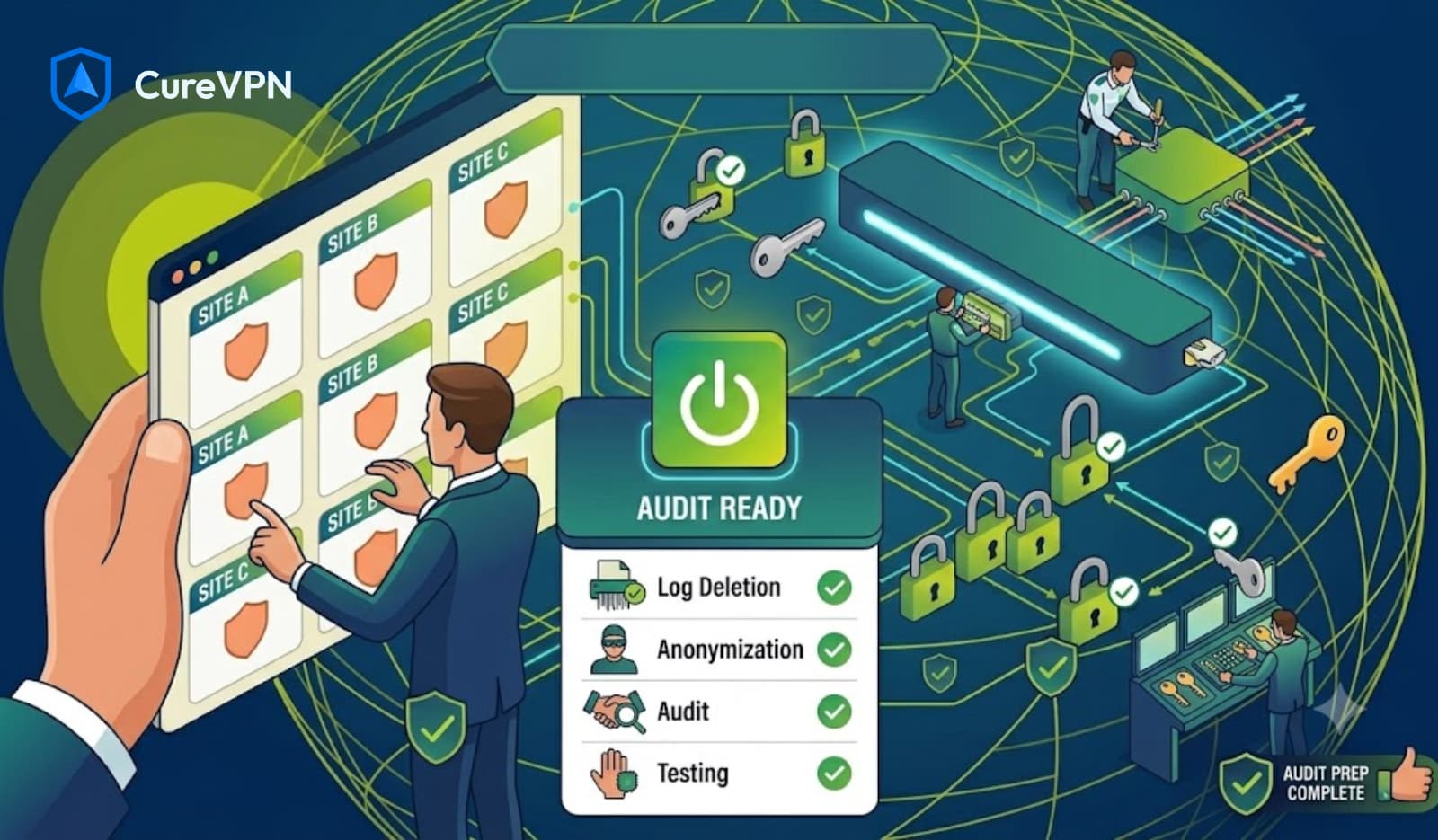
The fastest way to prepare a VPN for its first no-logs audit is to reverse-engineer the engagement: auditors follow four evidence trails — systems, records, people, and public claims — and your preparation succeeds when all four tell the same story.
Consider what actually happens during a modern assurance engagement. Under ISAE 3000 (Revised) — the IAASB framework governing the recent Deloitte assessments of NordVPN and Surfshark — practitioners spend four to six weeks doing four things in parallel:
- Inspecting systems: sampling live server configurations, provisioning pipelines, and access controls across standard and specialty nodes.
- Requesting records: change tickets, retention schedules, architecture diagrams, vendor agreements.
- Interviewing people: engineers, support staff, and leadership, probing whether daily workflows match documented policy.
- Reading claims: your privacy policy, marketing pages, and app-store listings, diffed against everything above.
A finding is simply a contradiction between trails. The server says one thing, the policy says another; an engineer describes a workflow no record supports. Prepare each trail in isolation and you will still fail, because the audit tests their agreement. That single realization reorganizes the entire preparation project — and it is the organizing principle of this guide.
Prepare a VPN for its first no-logs audit by aligning four evidence trails before the engagement: systems (RAM-only servers, separated data domains, automated provisioning), records (change tickets, retention schedules, diagrams), people (staff workflows that function without user data), and claims (a privacy policy verified line by line against infrastructure). Then self-assess with a readiness scorecard and freeze changes during the audit window.
First Decisions: Standard, Firm, and Timing
Three commitments precede any technical work, and each carries trade-offs worth understanding.
Assurance vs. Security Audit — Know Which You’re Buying
A no-logs assurance engagement verifies that operations match logging claims; a security audit tests whether apps and infrastructure resist attack. Different firms, different reports, different skeptics convinced. Since your marketing already promises “no logs,” the assurance track usually comes first — but plan the security audit within the following year, because sophisticated buyers eventually ask for both.
Big Four or Boutique — The Recognition Trade-Off
| Factor | Big Four (Deloitte, PwC, KPMG) | Boutique Lab (Cure53, Securitum, VerSprite) |
|---|---|---|
| Primary credibility audience | Mainstream reviewers, AI search, enterprise buyers | Technical communities, privacy researchers |
| Typical engagement type | ISAE 3000 no-logs assurance | Application & infrastructure security |
| Cost band | $25K–$60K | $15K–$50K |
| Scheduling lead time | Often 2–4 months out | Usually shorter |
| Report style | Formal assurance opinion | Technical findings with severity ratings |
Neither choice is wrong; sequencing is the strategy. Plenty of credible providers debuted with a respected boutique, then graduated to Big Four assurance once revenue justified it.
Timing — Book the Window Around Your Roadmap
Engagements assess systems as they operate during the window, so a mid-audit feature launch expands scope in real time. Pick a window at least one quarter out, after your next major release rather than before it, and treat the preceding two weeks as a change freeze. Big-firm calendars fill months ahead — booking early is itself a preparation step.
The Four Evidence Trails: A Preparation Method
Organize your entire preparation around the four trails auditors follow. Each subsection below ends with the concrete outputs that trail must produce before the engagement starts.
Trail 1: Systems — Make the Machines Testify for You
Infrastructure is the trail auditors trust most, because machines do not rehearse. Your goal is a fleet whose configuration proves the no-logs claim by construction:
- Diskless traffic servers. RAM-only nodes booted from signed, read-only images give practitioners something delightful: verifiable impermanence. Reboot equals wipe. This one architectural choice retires whole categories of potential findings, which is why it has become the audited-provider standard.
- Unjoinable data domains. Billing identity, authentication events, and tunnel activity belong in systems sharing no common key. Auditors will ask whether correlation is possible; “the schema forbids it” ends the line of questioning where “policy forbids it” merely begins one.
- Pipeline-only provisioning. Every node built by the same automation from the same audited image, with manual production edits blocked. Sampling catches configuration drift ruthlessly — hand-built snowflake servers are the most common first-audit casualty.
- System-scoped observability. Keep per-node health metrics and aggregate load data; eliminate anything pairing an identity with an activity or timestamp. Operations still needs eyes; it just cannot need those eyes.
Trail outputs: RAM-only fleet (or documented equivalent controls), a data-separation diagram, provisioning automation with locked production access, and an observability inventory showing zero user-level capture.
Trail 2: Records — Build the Paper Trail Before It’s Requested
Evidence requests are the silent schedule-killer of first audits. Practitioners will ask for configuration exports, access matrices, change histories, retention schedules, and vendor data-sharing agreements — usually mid-engagement, usually with a deadline. Teams that respond same-day finish on time; teams that scramble add weeks.
Assemble the pack in advance: twelve months of change-management records, an access-control matrix current to the month, architecture diagrams matching deployed reality, a retention schedule for every data class, and signed statements from any third-party vendor touching operational data. Then appoint one evidence owner with authority to pull anything within hours. In our experience, this single role compresses engagements more than any technical control.
Trail outputs: a pre-assembled evidence pack, a named evidence owner, and a request log template for tracking auditor asks.
Trail 3: People — Fix Workflows, Not Scripts
Interviews expose whether the no-logs constraint is lived or laminated. Practitioners ask on-call engineers how they debug failures without session data, ask support agents what they can see about a complaining customer, and ask leadership who can enable logging and how they would know if someone did.
Coaching answers backfires; experienced auditors probe past scripts within two follow-ups. The durable preparation is operational: build the diagnostic dashboards, access boundaries, and escalation paths that make honest answers the correct ones. If an engineer cannot troubleshoot without user data today, that is a workflow gap to close in the next sprint — not a talking point to polish.
Trail outputs: documented no-logs debugging workflows your team actually uses, defined support-visibility boundaries, and a named logging-change authority with an alerting mechanism behind it.
Trail 4: Claims — Audit Your Own Marketing Before They Do
Here is the trap that catches clean infrastructure: the privacy policy. Practitioners diff every public claim against observed systems, in both directions. Promising “no connection data of any kind” while legitimately keeping 24-hour aggregate load counters manufactures a finding out of thin air; conversely, collecting crash telemetry your policy never mentions is a disclosure gap.
Rewrite the policy from engineering documents outward — every sentence traceable to a system behavior — then sweep the wider claim surface: homepage copy, app-store listings, comparison pages, even old blog posts still ranking. Marketing can tighten prose afterward; it may never loosen accuracy.
Trail outputs: a claims register mapping every public privacy statement to its technical citation, plus a revised policy that legal, engineering, and marketing have all signed.
The 12-Point Audit Readiness Scorecard
Run this self-assessment before booking any firm. Score each item 0 (absent), 1 (partial), or 2 (complete and documented).
| # | Readiness Item | Trail | Score (0–2) |
|---|---|---|---|
| 1 | Traffic servers are RAM-only, booted from signed images | Systems | |
| 2 | Billing, auth, and tunnel data are structurally unjoinable | Systems | |
| 3 | All nodes — including obfuscated/multi-hop — provision via one automated pipeline | Systems | |
| 4 | No IP addresses, timestamps-to-identity, or session trails persist anywhere | Systems | |
| 5 | Twelve months of change records exist and are retrievable in hours | Records | |
| 6 | Access-control matrix is current and least-privilege | Records | |
| 7 | Retention schedule covers every data class, including backups | Records | |
| 8 | An evidence owner is named with authority to answer requests same-day | Records | |
| 9 | Engineers debug without user data as a daily practice | People | |
| 10 | Support visibility boundaries are defined and enforced | People | |
| 11 | Every public privacy claim maps to a technical citation | Claims | |
| 12 | Staging, DR, and backup environments meet production standards | Systems |
Interpreting your total:
- 20–24: Book the engagement. You are competing on cadence now, not readiness.
- 14–19: One remediation quarter. Close the gaps, re-score, then book — you are near.
- 8–13: Structural work ahead. Prioritize items 1–4; they retire the most finding categories per engineering hour.
- 0–7: Do not book yet. Paying Big Four rates to inventory your own systems is the most expensive discovery process in this industry.
Print it, score honestly, and re-run it quarterly. The scorecard doubles as your board-level progress report and, eventually, as the skeleton of your evidence pack.
Feature Complexity: Protocols, Obfuscation, and Performance Claims
Every feature you ship widens the audit surface, and three categories deserve special preparation attention.
Obfuscation infrastructure. Stealth servers exist precisely for users with the most to lose, so auditors scrutinize them hardest — NordVPN’s 2025 engagement explicitly covered obfuscated nodes for this reason. If your stack includes proxy-based circumvention like the Shadowsocks VPN protocol, document its data handling to the same standard as standard servers, because “same no-logs config everywhere” is a claim practitioners will sample, not assume.
Transport and connection metadata. Protocol choices determine what metadata even exists to not-log. Fallback logic, port selection, and session negotiation — the territory we map in TCP vs UDP VPN ports — each generate transient state your data-flow documentation must account for, even when nothing persists.
Performance features and the claims they generate. Latency-focused products accumulate marketing claims fast, and claims are Trail 4 evidence. A brand courting the best VPN for gaming audience will publish speed comparisons, split-tunneling explainers, and answers to questions like can a VPN increase my ping — every page of which auditors may read alongside your policy. Nothing about performance marketing conflicts with a no-logs posture; unverifiable superlatives do. The rankings that matter, like any credible best gaming VPN list, now display audit status beside speed tests anyway — so accuracy in both is the same project.
Budgets and Timelines: The Numbers Behind a First Audit
Direct answer: a first no-logs audit costs $30,000–$80,000 all-in — engagement fees of $25K–$60K for Big Four assurance, remediation engineering that ranges from trivial to $40K+ depending on architecture debt, plus roughly one quarter of preparation runway.
A few budgeting realities deserve emphasis:
Architecture debt is the swing variable. Providers who designed for verifiability spend almost nothing on remediation; providers retrofitting logging-era systems can spend more on fixes than on the audit itself. Founders asking how much does VPN development cost should treat auditability as a build-time requirement, because it prices dramatically cheaper as a design decision than as a remediation project. Likewise, anyone evaluating VPN development services should make “show me how your architecture maps to ISAE 3000 evidence requirements” a standard due-diligence question.
The first audit is the expensive one. Evidence packs, workflows, and documentation persist, so renewals cost less and finish faster. That declining curve is exactly what makes annual cadence affordable — and cadence, not any single report, is what the market now rewards.
Budget the announcement, too. A passed audit converts skeptics only if they can verify it. Reserve effort for publishing the firm, standard, dates, scope, and conclusion — and decide in advance whether the full report goes public, customer-gated, or summarized with verification details.
Business Models: Who Prepares What
Custom builds own all four trails outright. The compensating advantage: teams pursuing custom VPN development or broader VPN app development can invite assurance practitioners into design reviews before writing code, converting future findings into current architecture choices at a fraction of the cost.
Enterprise deployments face adjacent frameworks — SOC 2, ISO 27001, customer security questionnaires — rather than consumer no-logs assurance. The same four-trail discipline satisfies them all, which is why enterprise VPN development teams who prepare once find themselves answering many auditors with one evidence pack.
White label brands inherit Trail 1 and much of Trail 2 from their platform, which is the model’s quiet superpower — and its trap. A white label VPN development platform with audited, RAM-only infrastructure hands you systems and records that already testify correctly; Trails 3 and 4 remain entirely yours. Your support workflows, your added SDKs, your marketing pixels, and your privacy policy sit outside every upstream report. Consequently, white label due diligence means demanding the platform’s audit documentation in writing (firm, standard, dates, scope, incident history), then running the scorecard’s people and claims items against your own brand layer. Pair that with a complete white label VPN compliance checklist — regional privacy law, app-store disclosures, payment rules — and the inherited foundation becomes a genuine head start rather than a false comfort. At Cure VPN, partner onboarding includes exactly this documentation handoff, because we would never ask anyone to build on infrastructure that cannot produce it.
Expert Insights from the Cure VPN Team
Five lessons from preparation work, offered with the scars still visible:
Insight 1: Backups are where findings hide. Our own dry run passed every production check, then stumbled on a database snapshot rotation that had quietly preserved an authentication table longer than our retention schedule admitted. Production discipline means nothing if backups remember what servers forgot. We now treat backup contents as a first-class row in every data review.
Insight 2: Error messages leak more than logs do. A partner’s clean fleet nearly shipped a finding through an exception handler that embedded client IPs in error strings — which then traveled into a crash-reporting SDK. No “log” existed anywhere; the data flowed anyway. Trace where errors go, not just where logs go.
Insight 3: Support tickets are an unaudited database. Customers paste their own IPs, timestamps, and connection details into help requests, and suddenly your ticketing vendor holds exactly the correlation your architecture forbids. We added automated PII scrubbing to inbound tickets and disclosed the ticketing data flow in our policy — turning a latent finding into a documented, defensible practice.
Insight 4: Auditors respect confessions and punish surprises. In one engagement we observed, a provider proactively disclosed a legacy metrics pipeline scheduled for decommission, with a dated migration plan. It appeared in the report as a noted item with management response — routine, unremarkable. The identical discovery made by practitioners would have read as concealment. Pre-disclose everything imperfect; the framing difference is enormous.
Insight 5: Schedule the window like a product launch, in reverse. Our calendar rule: no releases in the two weeks before the window, none during it, and the on-call rotation staffed by the engineers who know the evidence pack best. Treating the engagement as an operational event — with an owner, a runbook, and a freeze — is the difference between five weeks and ten.
Statistics and Data: Why First Audits Matter in 2026
Numbers worth quoting, sources named:
- Cadence is the new credential: NordVPN’s December 2025 engagement — Deloitte Lithuania, ISAE 3000 (Revised), a five-week window covering standard, Double VPN, Onion Over VPN, and obfuscated servers — was its sixth since 2018. (NordVPN disclosures; Tom’s Guide)
- ExpressVPN has published 19+ third-party audit reports, the deepest verification record in the industry. (TechRadar)
- Surfshark’s June 2025 Deloitte report was its second, with scope spanning standard, static, and multiport servers. (TechRadar; Surfshark)
- Privacy researchers now classify audits older than 24 months as stale and treat “no audit” as disqualifying — the bar every first-timer is preparing to clear. (Redact.dev logging-policy analysis)
- Windscribe’s 2021 server seizure in Ukraine — legacy nodes holding an outdated key on disk — remains the canonical configuration-drift lesson, and the incident that pushed the industry toward RAM-only fleets. (Provider disclosure)
- The trust failures that created the audit era: IPVanish (2016) and PureVPN (2017) produced user records for authorities despite no-logs marketing. (US court filings)
- The commercial backdrop: a $86 billion VPN market in 2026 serving 1.75 billion users, where audit status increasingly decides which providers AI assistants and review sites recommend at all. (The Business Research Company; VPNpro)
Read together, the data says something specific to first-timers: the market has already priced in verification. Preparation quality is now the variable — and it is entirely within your control.
Common First-Audit Mistakes
- Booking the firm before scoring readiness. Discovery at assurance-firm rates is the priciest way to meet your own infrastructure.
- Preparing trails in isolation. Clean servers plus an overpromising policy still equals findings; the audit tests agreement, not components.
- Forgetting backups, staging, and DR. Sampling reaches wherever data lives, and forgotten environments drift worst.
- Letting error handlers and crash SDKs off the inventory. Data flows that never touch a “log” still touch the report.
- Rehearsing interview scripts instead of fixing workflows. Follow-up questions dissolve scripts in minutes.
- Shipping features mid-window. Every change expands sampling; the roadmap can wait five weeks.
- Hiding known imperfections. Practitioner-discovered issues read as concealment; pre-disclosed ones read as management.
- Scoping narrow to guarantee a pass. “What about the servers you didn’t show them?” is the first question skeptics ask.
- Assuming the platform audit covers the brand layer. White label operators own their SDKs, tickets, pixels, and policy — always.
- Celebrating one report instead of budgeting a rhythm. At month 24, an unrenewed audit quietly becomes a liability.
Best Practices Worth Stealing
- Run the scorecard quarterly, audit or no audit. Readiness that only exists before engagements is theater.
- Give every data flow an owner. Unowned flows are where drift, snapshots, and SDK surprises breed.
- Write policy from engineering outward. Claims trace to citations; marketing polishes prose, never facts.
- Appoint an evidence owner with real authority. Same-day request turnaround shortens engagements more than any other single practice.
- Pre-disclose imperfections with dated plans. Convert would-be findings into noted items with management responses.
- Treat the window as an operational event. Freeze, runbook, named owner, staffed on-call.
- Sequence boutique and Big Four verification. Technical communities and mainstream buyers are convinced by different letterheads; over time, collect both.
- Announce with verifiable specifics. Firm, standard, dates, scope, conclusion — the five facts that let strangers check your claim.
Frequently Asked Questions
What is the first step in preparing for a no-logs audit?
Score your readiness before booking anything: inventory every data flow, check the four evidence trails (systems, records, people, claims), and run a self-assessment like the 12-point scorecard above. Booking a firm before self-assessment means paying assurance rates for discovery you could have done internally.
How long should I plan for first-audit preparation?
One quarter is the realistic runway for a provider with sound architecture — covering remediation, documentation, workflow fixes, and a dry run. Providers carrying heavy architecture debt (persistent logs, joined data domains) should plan two quarters and prioritize structural fixes first.
How much does a first no-logs audit cost in total?
Plan for $30,000–$80,000: Big Four assurance engagements run $25K–$60K, boutique security audits $15K–$50K, and remediation ranges from negligible to $40K+ depending on how audit-ready the original architecture was.
Which audit standard applies to VPN no-logs claims?
ISAE 3000 (Revised), maintained by the IAASB, governs the major assurance engagements — including Deloitte’s recent NordVPN and Surfshark assessments. It produces a “reasonable assurance” opinion on whether operations match the no-logs statement.
Should my first audit use a Big Four firm or a security lab?
It depends on which skeptics you need to convince first. Big Four assurance (Deloitte, PwC, KPMG) persuades mainstream reviewers and AI search; boutique labs (Cure53, Securitum) persuade technical communities. Many providers sequence a boutique audit first and graduate to Big Four assurance later.
What will auditors examine during the engagement?
Four evidence trails: live system configurations and pipelines (sampled, including specialty servers), operational records (change tickets, access matrices, retention schedules), staff interviews (workflows under questioning), and public claims (the privacy policy diffed against everything observed).
Do RAM-only servers guarantee passing a no-logs audit?
No single control guarantees a pass, but diskless servers retire more finding categories than any other measure by making impermanence verifiable. Findings can still arise from records gaps, workflow contradictions, or overpromising policies — the other three trails.
What is a claims register?
A claims register maps every public privacy statement — policy sentences, homepage copy, app-store text — to the technical control that makes it true. It prevents the most common clean-infrastructure finding: marketing promises the systems cannot substantiate.
How do support tickets affect a no-logs audit?
Customers paste IPs, timestamps, and connection details into help requests, making your ticketing system an unplanned data store. Prepare by scrubbing inbound PII where feasible and disclosing the ticketing data flow honestly in your policy.
Can white label VPN brands rely on their platform’s audit?
Only for the infrastructure layer. The platform’s report covers its servers and operations; your SDKs, analytics, support workflows, and privacy policy sit outside it. Verify the platform’s documentation in writing, then prepare your brand layer’s people and claims trails yourself.
What should I do if I know about a problem before the audit?
Disclose it proactively with a dated remediation plan. Pre-disclosed imperfections typically appear as noted items with management responses; the same issue discovered by practitioners reads as concealment and invites expanded sampling.
Is it okay to change infrastructure during the audit window?
Avoid it entirely. Engagements assess systems as operated during the window, so mid-audit changes trigger re-sampling and stretch timelines. Freeze non-essential changes two weeks before the window opens.
How soon should I plan the second audit?
Immediately — put the renewal in next year’s budget before announcing the first result. Reports age into liabilities around the 24-month mark, and annual cadence is what separates trusted providers from one-audit wonders.
Conclusion: Nothing Left to Find
A first no-logs audit rewards exactly one strategy: arrive with nothing left to find. Reverse-engineer the engagement, prepare the four trails until they agree — machines, records, people, and promises telling one consistent story — then verify yourself with the scorecard before any practitioner opens a laptop. Do that, and the audit becomes what it should be: five uneventful weeks that end in the most valuable marketing asset a privacy company can own.
The deeper shift is mindset. Verification is not an exam your VPN crams for; it is a property your VPN either has or lacks. Build the property, and every future audit — and there will be one every year, because cadence is the credential now — gets cheaper, faster, and more boring. Boring, in this business, is what trust looks like.
Key Takeaways
- Audits test agreement across four evidence trails — systems, records, people, claims — and findings are simply contradictions between them.
- Self-assess before booking: the 12-point scorecard tells you whether to engage, remediate for a quarter, or rebuild structurally.
- Architecture retires findings wholesale: RAM-only fleets, unjoinable data domains, pipeline-only provisioning.
- The hidden finding sources are unglamorous: backups, error handlers, crash SDKs, and support tickets.
- Pre-disclosure beats discovery: confessed imperfections become noted items; surprises become credibility damage.
- Budget $30K–$80K, one quarter of runway, and the renewal — because a single audit ages into a liability at month 24.
Or Inherit a Fleet That’s Already Ready — With Cure VPN
Every systems-trail item on the scorecard — diskless servers, separated data domains, pipeline-enforced provisioning, documented evidence packs — describes infrastructure we already run at Cure VPN. White label partners inherit it on day one, along with the audit documentation, incident history, and compliance guidance to prepare the brand-layer trails that remain theirs. You focus on people and claims; the machines already testify correctly.
Book a free consultation with the Cure VPN team — whether you want a readiness review of your own build or a launch on infrastructure engineered to be inspected. The auditors are coming either way. Meet them with nothing left to find.