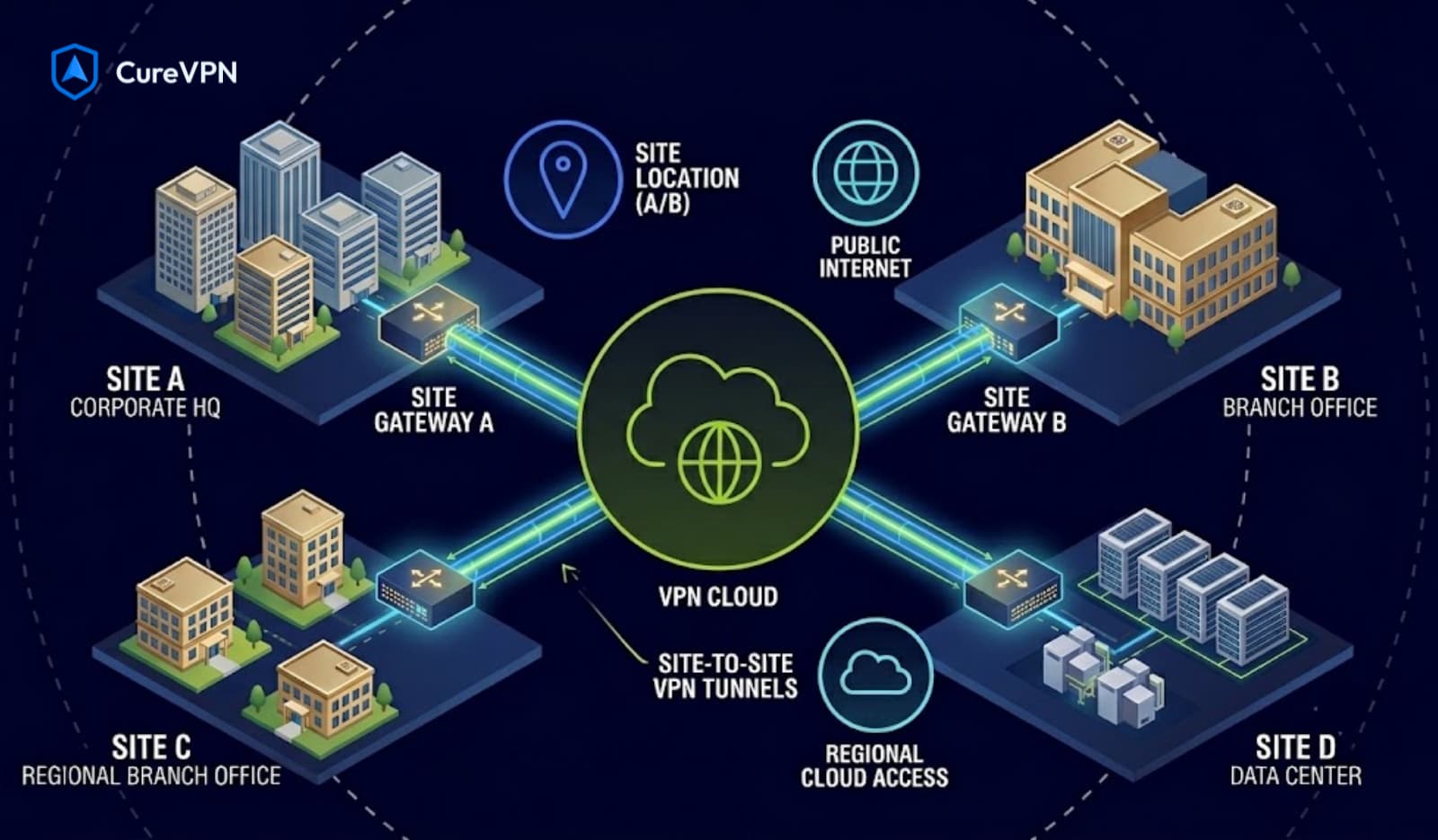


A Business VPN (Virtual Private Network) is an enterprise-grade encrypted tunnel that secures all data transmitted between your employees, devices, and company servers — regardless of where those users are physically located.
Unlike a personal VPN you might use for streaming, a Business VPN is purpose-built for multi-user environments. It handles centralized access controls, team-level permissions, audit logging, and consistent AES-256 encryption across every connection point in your organization.
Put simply: it’s not just privacy. It’s operational security at scale.
Why Businesses Can’t Afford to Skip a VPN in 2026?
The numbers are hard to ignore.
The global VPN market was valued at $69.82 billion in 2025 and is projected to reach $336.67 billion by 2034, growing at a CAGR of 19.10%. That kind of growth doesn’t happen without a real underlying need.
As of 2025, 93% of large enterprises report using VPNs or similar secure remote access tools. And it’s not just the big players feeling the pressure. Small and mid-sized businesses are increasingly targeted precisely because they’re assumed to have weaker defenses.
Roughly 35.5 million Americans teleworked for pay in the first quarter of 2024 — a 5.1 million increase year-over-year — representing 22.9% of the total workforce. Every one of those remote workers is a potential entry point for attackers if their connection isn’t encrypted.
The risk isn’t theoretical. It’s daily.
The Real Problem: Why Standard Security Isn’t Enough
Most businesses already have antivirus software, firewalls, and password policies. So why do data breaches keep happening?
Because perimeter-based security assumes your employees are inside a controlled network. They aren’t. They’re working from coffee shops, hotel lobbies, airport lounges — connecting via public Wi-Fi that has zero encryption and full exposure to man-in-the-middle attacks.
About 58% of VPN users rely on one specifically when connecting to airports, cafés, hotels, and public hotspots — and that number is rising sharply due to MITM attacks.
Here’s the agitation point: a single compromised employee device can expose your entire network. Client data, financial records, intellectual property — all of it sits behind a door your team might be leaving open without realizing it.
A Business VPN closes that door. Every time. For every user.
Business VPN vs. Consumer VPN: Why the Distinction Matters
If you’re using a consumer-grade VPN to protect your business operations, you’re already one step behind.
Here’s the core difference:
| Feature | Consumer VPN | Business VPN |
|---|---|---|
| User management | Single account | Centralized multi-user admin |
| Access controls | None | Role-based permissions |
| Audit logs | Rarely available | Standard feature |
| Dedicated IP | Optional add-on | Usually included |
| Kill switch | Yes | Yes + policy enforcement |
| Scalability | 5–10 devices max | Scales to thousands |
| Support | Community/ticketing | Priority SLA-backed |
A best free VPN might work fine for personal browsing. For a team of 20 people accessing sensitive company data across three countries, it won’t cut it. Free tiers rarely offer the audit trails, dedicated IPs, or centralized controls that compliance frameworks like GDPR, HIPAA, and SOC 2 actually require.
Key Features to Look for in a Business VPN
Not all business VPN solutions are built the same. When evaluating options, focus on these non-negotiables:
1. AES-256 Encryption
This is the gold standard. AES-256 is what governments and financial institutions use to protect classified data. Anything less leaves your traffic vulnerable to decryption.
2. Tunneling Protocol Support
Look for support across multiple protocols: WireGuard (fastest, lowest CPU overhead), OpenVPN (battle-tested, open-source), and IKEv2/IPSec (optimal for mobile). WireGuard in particular is worth prioritizing — benchmarks on Ubuntu 22.04 show WireGuard reaching 920–960 Mbps download versus OpenVPN’s 650–780 Mbps, while using only 8–15% CPU compared to OpenVPN’s 45–60% during transfers.
3. Centralized Admin Dashboard
Your IT team needs to onboard new employees, revoke access instantly when someone leaves, and monitor connections in real time — all from one place.
4. Multi-Tenant Infrastructure
Enterprise-grade VPNs use logically separated environments so that your company’s data never comingles with another client’s. This is critical for regulated industries.
5. Kill Switch + DNS Leak Protection
If the VPN connection drops unexpectedly, a kill switch cuts the internet entirely rather than exposing your raw IP. DNS leak protection ensures your queries never escape the encrypted tunnel.
6. Split Tunneling
This lets you route business traffic through the VPN while allowing personal or low-risk traffic through the local connection. It preserves bandwidth without sacrificing security where it matters.
7. Dedicated IP Addresses
Shared IPs get flagged by firewalls, rate-limiters, and banking portals. A dedicated IP tied to your business means consistent access without authentication friction.
How a Business VPN Protects Remote and Hybrid Teams
The shift to hybrid work didn’t just change where people work. It fundamentally expanded your company’s attack surface.
Before 2020, most enterprise security models assumed employees were inside a corporate network. Everything flowed through a central hub with firewalls, intrusion detection systems, and physical access controls. That model is effectively obsolete.
Today, your “network” is everywhere your employees are. A Business VPN brings those distributed endpoints back under a unified security umbrella — without requiring everyone to physically return to an office.
Remote access VPNs account for 67.8% of the managed VPN market, reflecting the growing need for secure connectivity for remote employees and mobile users. This isn’t a niche use case. It’s how modern businesses operate.
For teams using mobile devices, this matters even more. Employees checking company email or accessing internal tools via their phone need the same protection as someone on a laptop. A VPN for iPhone or Android ensures that mobile traffic goes through the same AES-256 encrypted tunnel as desktop connections — something consumer apps rarely enforce consistently.
Business VPN for Security: Compliance, Liability, and Risk Reduction
Beyond protecting your data, a VPN for security plays a direct role in regulatory compliance.
GDPR requires that personal data be transmitted securely. HIPAA mandates encrypted communications for health-related information. PCI-DSS requires encrypted cardholder data in transit. Failing any of these audits isn’t just embarrassing — it’s expensive. Fines under GDPR alone can reach €20 million or 4% of global annual turnover.
BFSI (banking, financial services, and insurance) organizations commanded 29.40% of VPN market revenue — the largest share of any industry vertical. That’s because the financial sector understands that the cost of a VPN is a fraction of the cost of a breach.
For businesses in regulated industries, a Business VPN isn’t optional infrastructure. It’s a compliance requirement wrapped in network security.
Pricing Reality: What Does a Business VPN Actually Cost?
Here’s where many businesses get either oversold or undersold.
At the low end, some providers offer cheap VPN plans starting at $3–5/month per user. These can be legitimate options for very small teams with minimal compliance requirements — but read the fine print. Cheap plans often strip out dedicated IPs, audit logs, and priority support.
Mid-tier business plans run $8–15/month per user and typically include:
- Centralized admin controls
- Up to 10–15 simultaneous connections per account
- Standard AES-256 encryption
- Email or chat support
Enterprise-grade solutions start at $15–30/month per user but offer:
- Unlimited device connections
- SLA-backed uptime guarantees
- Dedicated account managers
- Custom onboarding and network configuration
- SSO (Single Sign-On) integration
Looking for best affordable VPN options that still deliver enterprise features? Focus on WireGuard-based providers — they’re inherently more resource-efficient, which often translates to better pricing without sacrificing speed or security.
The math is straightforward. A team of 25 paying $12/month per user spends $3,600/year on a business VPN. The average cost of a data breach in 2024 was $4.88 million (IBM). The ROI practically argues itself.
Best Free VPN Services vs. Paid Business Plans
Let’s address this directly: best free VPN services exist, and some are genuinely useful — for personal use.
For business, the tradeoffs become unacceptable quickly:
What free VPN plans typically sacrifice:
- No dedicated business IP (your IP is shared with thousands of random users, which gets flagged by corporate systems)
- No audit logs (instant compliance failure)
- Data caps (often 500MB–10GB/month — one video call blows through that)
- Fewer server locations (latency problems for globally distributed teams)
- Weaker encryption or outdated protocols
- No centralized user management
There’s also a harder question worth asking: if you’re not paying for the product, how is the provider making money? Some free VPN providers have been documented selling anonymized (or not-so-anonymized) user data to advertisers. That’s the last arrangement a business wants.
For personal use, evaluating the best free VPN options makes sense. For protecting client data and company infrastructure, invest in a paid solution.
Gaming, Development, and Niche Business Use Cases
VPN use in business extends well beyond protecting remote workers.
Software development teams use VPNs to access staging environments, internal repositories, and cloud infrastructure securely. A best VPN for gaming might seem unrelated to enterprise use — but the same low-latency, high-throughput infrastructure that makes a best gaming VPN effective also benefits developers running latency-sensitive tests against production systems.
E-commerce businesses use VPNs to monitor competitors’ localized pricing in different regions without tipping off their actual location.
Media and content teams rely on VPNs to access geo-restricted research tools, international social platforms, and region-specific analytics dashboards.
SaaS companies with globally distributed engineering teams use site-to-site VPNs to create secure tunnels between their cloud infrastructure and developer workstations — regardless of which country those developers are sitting in.
The point: a Business VPN isn’t just for the IT department. It’s infrastructure that touches every team that touches sensitive data.
Zero Trust vs. VPN: Understanding the Evolution
A common question in enterprise security circles: with Zero Trust Network Access (ZTNA) gaining momentum, is the traditional VPN becoming obsolete?
The honest answer: not yet — and for most businesses, not for a long time.
The VPN market is moving toward Zero Trust architectures, where every user and device must be continuously authenticated — integrating identity-based security with encrypted connectivity. But this evolution is additive, not replacement.
Most organizations today are running a hybrid model: VPNs for encrypted tunneling and network-level access, layered with identity verification, MFA, and endpoint monitoring. While 65% of organizations plan to replace traditional VPNs within a year according to Zscaler’s 2025 report, 81% are expected to adopt Zero Trust models — though most still use encrypted tunneling on gateways.
The practical takeaway for most businesses: deploy a modern Business VPN now, choose one that supports ZTNA integration as an upgrade path, and don’t let the perfect be the enemy of the secure.
How to Set Up a Business VPN: A Framework for Getting Started
Getting a Business VPN deployed doesn’t require an enterprise IT team. Here’s a practical framework:
Step 1 — Audit your access points List every device, location, and user that connects to company resources. Include mobile devices, home offices, and third-party contractors.
Step 2 — Define your compliance requirements Are you handling health data (HIPAA), financial data (PCI-DSS), or EU customer data (GDPR)? Your compliance tier determines which VPN features are non-negotiable.
Step 3 — Choose your deployment model
- Cloud-based VPN: Fastest to deploy, managed by the provider, ideal for teams under 100 users
- Self-hosted VPN: More control, higher setup complexity, better for regulated industries needing data residency
Step 4 — Evaluate providers on these criteria Protocol support (WireGuard preferred), server locations, admin dashboard, audit logging, kill switch, dedicated IP availability, and support SLA.
Step 5 — Roll out with a pilot group Deploy to your IT team or a single department first. Stress-test the kill switch, measure latency impact, and verify that split tunneling works for your specific use case.
Step 6 — Train your team A VPN only works if people use it. Create a one-page guide explaining when to connect (always, on all networks outside the office) and what the kill switch does.
Frequently Asked Questions (FAQs)
What is a Business VPN used for?
A Business VPN encrypts all data transmitted between employees and company servers. It’s used for securing remote access, protecting data on public Wi-Fi, enabling site-to-site connectivity between offices, and meeting regulatory compliance requirements like GDPR and HIPAA.
Is a Business VPN different from a personal VPN?
Yes — significantly. Business VPNs include centralized user management, role-based access controls, audit logging, dedicated IPs, and SLA-backed support. Personal VPNs are designed for single users and rarely include the compliance or administrative features businesses need.
How much does a Business VPN cost?
Costs range from $5/month per user for basic plans to $30+/month per user for enterprise solutions. Most teams of 10–50 people land in the $8–15/month per user range, which covers AES-256 encryption, centralized admin controls, and reliable support.
Can a Business VPN work on mobile devices?
Yes. Most modern Business VPN providers support iOS and Android. Employees using a VPN for iPhone or Android device get the same encrypted tunnel as desktop users — critical for teams that work on the go.
Are free VPN services safe for business?
Generally, no. Best free VPN services lack the audit logs, dedicated IPs, and compliance certifications that business use requires. Many free providers monetize through data collection, which creates direct liability for businesses handling client information.
What encryption does a Business VPN use?
The industry standard is AES-256 (Advanced Encryption Standard with 256-bit keys). This is the same encryption used by government agencies and financial institutions. Pair it with WireGuard or OpenVPN protocol and you have a robust, auditable security layer.
How does a Business VPN help with gaming or low-latency applications?
WireGuard-based VPNs offer near-native connection speeds. Teams working with real-time collaboration tools, video conferencing, or developers testing latency-sensitive applications will benefit from the same infrastructure that powers the best gaming VPN services — without sacrificing encryption.
What’s the difference between a cheap VPN and an affordable business VPN?
A cheap VPN focuses on price with feature tradeoffs. A best affordable VPN delivers genuine business value — AES-256 encryption, WireGuard protocol, admin controls — at a price point that doesn’t require enterprise budgets. Look for providers that offer all core business features without charging separately for each one.
Should small businesses use a VPN?
Absolutely. Small businesses are disproportionately targeted in cyberattacks precisely because attackers assume weaker defenses. A Business VPN provides enterprise-grade encryption at a cost most small teams can absorb — and it takes minutes to deploy with a cloud-based solution.
What is the future of Business VPNs?
The trajectory points toward tighter integration between VPN infrastructure and Zero Trust security models. Post-quantum encryption is already rolling out across major providers. ExpressVPN upgraded its Lightway protocol with ML-KEM post-quantum encryption, and NordVPN introduced PQE across all platforms. Businesses that invest in modern VPN infrastructure today are building toward a quantum-resistant security posture for tomorrow.
The Bottom Line
A Business VPN is one of the highest-leverage security investments a company can make. It protects remote workers, secures client data in transit, satisfies compliance auditors, and scales with your team without requiring a dedicated IT department to manage it.
The question isn’t whether your business needs one. It’s whether you can afford the consequences of operating without one.
Whether you’re evaluating a best free VPN as a starting point, comparing cheap VPN options for a small team, or scoping enterprise-grade infrastructure for 500 employees — start from a clear understanding of your threat surface, your compliance obligations, and the features that actually matter.
The right Business VPN doesn’t just protect your data. It protects your reputation, your clients, and the business you’ve worked to build.