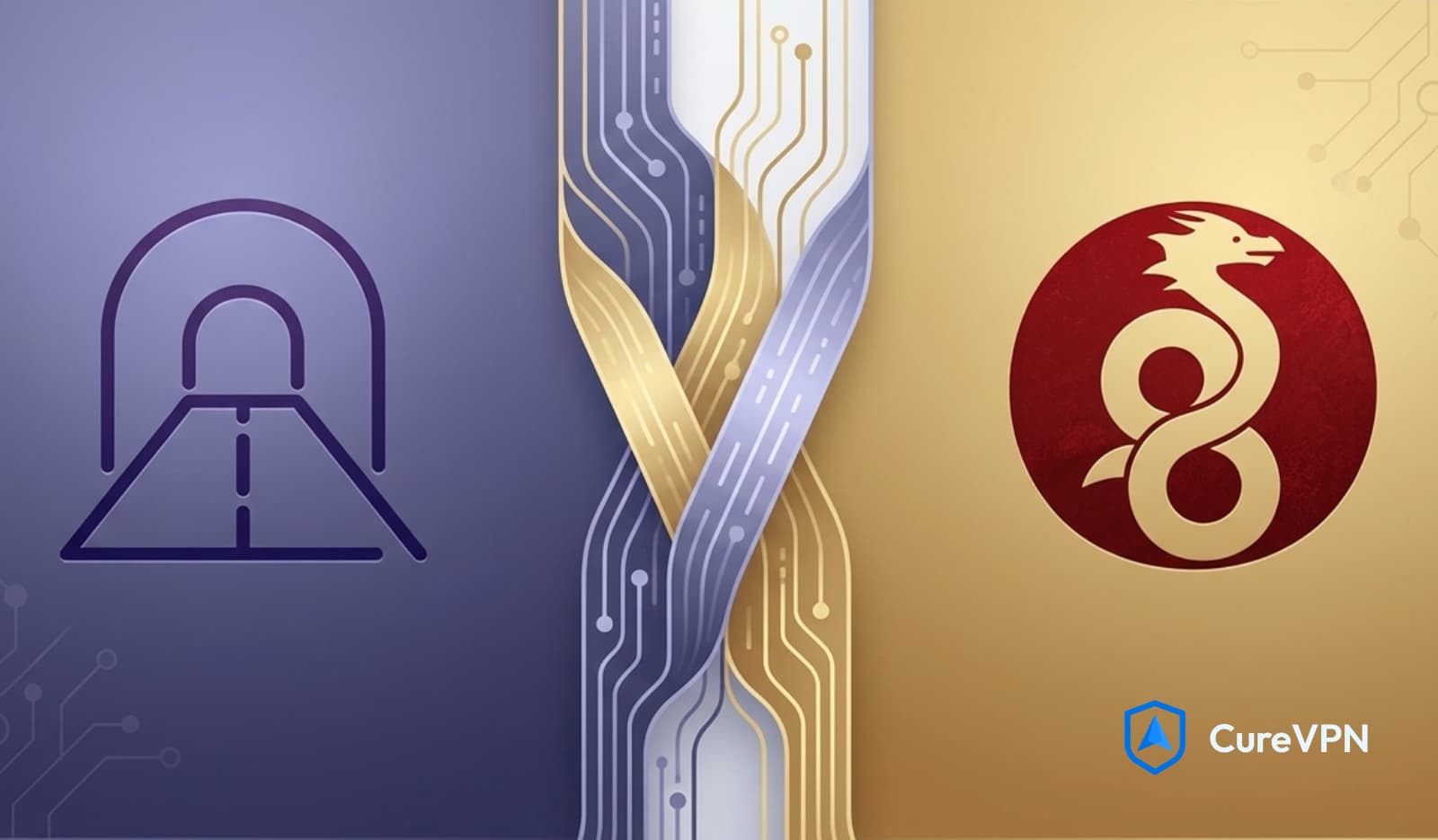

The IKEv2 vs WireGuard debate isn’t just a technical footnote — it’s the most important decision you’ll make when deploying or choosing a VPN in 2026. Both protocols are fast, both are secure, and both are widely supported. But they solve different problems in meaningfully different ways, and picking the wrong one for your use case will cost you in speed, reliability, or security.
This guide breaks down every dimension of the comparison: architecture, encryption standards, real-world performance benchmarks, platform support, and the specific scenarios where one definitively outperforms the other. Whether you’re a VPN business owner evaluating your protocol stack, a developer building on top of a VPN SDK, or a technically-informed user who wants to know exactly what’s protecting their traffic — this is the complete answer.
What Is IKEv2?
IKEv2 (Internet Key Exchange version 2) is a tunneling protocol developed jointly by Microsoft and Cisco in the early 2000s, standardized in RFC 7296. It doesn’t operate alone — IKEv2 always pairs with IPSec (Internet Protocol Security) for the actual data encryption, which is why you’ll often see it written as IKEv2/IPSec.
IKEv2 handles the key exchange and session negotiation process. IPSec then encrypts and authenticates each data packet within the established tunnel.
📌 Featured Snippet Definition: IKEv2 is a VPN tunneling protocol that establishes and manages secure connections through asymmetric key exchange. It always operates alongside IPSec for data encryption, supporting AES-256, SHA-2, and ECC cipher suites.
Core IKEv2 Characteristics
- Protocol type: Tunneling + key exchange (paired with IPSec)
- Default transport: UDP port 500 (falls back to UDP 4500 for NAT traversal)
- Encryption support: AES-128, AES-256, 3DES, Camellia
- Authentication: HMAC-SHA1, HMAC-SHA2, EAP, certificates
- Code size: ~400,000 lines
- Key feature: MOBIKE (Mobility and Multihoming Protocol) — seamless network switching
- First standardized: 2005 (RFC 4306); updated 2014 (RFC 7296)
The MOBIKE extension is what makes IKEv2 particularly valuable for mobile devices. When a device switches from Wi-Fi to a cellular network, IKEv2 maintains the VPN tunnel without requiring a full reconnection. Android, iOS, Windows, and macOS all include native IKEv2 support.
What Is WireGuard?
WireGuard is a modern, open-source VPN protocol created by security researcher Jason Donenfeld and first published in 2015. Linus Torvalds called it “a work of art” when it was merged into the Linux kernel 5.6 in March 2020 — which tells you a great deal about how the engineering community received it.
Unlike IKEv2/IPSec’s complex, multi-layered architecture, WireGuard was built with radical simplicity as a core design principle. The result is a codebase of roughly 4,000 lines — versus IKEv2’s ~400,000 — making it dramatically easier to audit, maintain, and verify for vulnerabilities.
📌 Featured Snippet Definition: WireGuard is a modern open-source VPN protocol that uses state-of-the-art cryptography (ChaCha20, Poly1305, Curve25519, BLAKE2s) to create fast, lightweight encrypted tunnels. It runs in the Linux kernel and is available across all major platforms.
Core WireGuard Characteristics
- Protocol type: VPN tunneling protocol
- Default transport: UDP only
- Encryption: ChaCha20-Poly1305 (data), Curve25519 (key exchange), BLAKE2s (hashing), SipHash24 (hashtable keys)
- Authentication: Public-key cryptography only
- Code size: ~4,000 lines
- Key feature: Cryptokey routing — peers identified by public keys, not IP addresses
- Kernel integration: Linux kernel 5.6+ (March 2020)
- First published: 2015; stable release 2020
WireGuard’s cryptographic suite is modern and opinionated — it doesn’t offer cipher negotiation. Every connection uses the same algorithms, which eliminates entire categories of downgrade attacks and configuration errors that plague more flexible protocol stacks.
IKEv2 vs WireGuard — Head-to-Head Comparison
| Feature | IKEv2/IPSec | WireGuard |
|---|---|---|
| Code size | ~400,000 lines | ~4,000 lines |
| Encryption | AES-256, AES-128, 3DES | ChaCha20-Poly1305 |
| Key exchange | Diffie-Hellman + RSA/ECC | Curve25519 |
| Hashing | HMAC-SHA2 | BLAKE2s |
| Transport | UDP (500 / 4500) | UDP only |
| Cipher agility | Yes (multiple options) | No (fixed suite) |
| Mobile reconnection | Excellent (MOBIKE) | Good (requires reconfiguration on some platforms) |
| Kernel integration | Yes (IPSec) | Yes (Linux 5.6+) |
| Audit complexity | High | Very low |
| Open source | Partially (IPSec is open, IKEv2 implementations vary) | Fully open source |
| NAT traversal | Yes (UDP 4500) | Yes (built-in) |
| IPv6 support | Yes | Yes |
| Setup complexity | Moderate-High | Low-Moderate |
| Default stealth | No | No |
| Best for | Mobile, enterprise, stability | Speed, simplicity, low-latency |
Speed: Which Protocol Is Actually Faster?
WireGuard is faster. That’s the short answer — but the full picture is more nuanced.
WireGuard operates in kernel space on Linux, which eliminates the overhead of context-switching between user space and kernel space that affects most other VPN implementations. Combined with ChaCha20’s hardware-independent efficiency (it’s fast on CPUs without AES-NI hardware acceleration), WireGuard consistently delivers higher throughput.
Benchmark Data
Independent testing by Wireguard.com and third-party sources like Ars Technica and security researcher Donenfeld’s own 2018 paper shows:
- WireGuard throughput: Typically 300–1,000+ Mbps depending on hardware
- IKEv2/IPSec throughput: Typically 150–600 Mbps on equivalent hardware
- OpenVPN throughput: Typically 100–300 Mbps (for context)
On mobile devices and low-power hardware (routers, embedded systems), the performance gap widens because WireGuard’s ChaCha20 doesn’t require dedicated AES hardware acceleration — while IKEv2’s AES-256 implementation does.
However, on modern Intel and ARM processors with AES-NI hardware acceleration (virtually all desktop and server CPUs since 2010, and most mobile chips since 2015), the gap narrows significantly. AES-NI makes IKEv2/AES-256 extremely fast — competitive with WireGuard in many real-world scenarios.
💡 Bottom line on speed: WireGuard wins on throughput, especially on older hardware and mobile. On modern hardware with AES-NI, the real-world difference for most users is under 10–15%.
Security & Encryption Depth
Both protocols are considered cryptographically secure by the security research community. However, they take fundamentally different philosophical approaches.
IKEv2/IPSec Security Model
IKEv2 supports cipher agility — it negotiates which encryption algorithm to use during handshake. This flexibility allows implementations to support legacy devices and be updated as cryptographic standards evolve. The downside: poorly configured implementations can be downgraded to weaker cipher suites through man-in-the-middle attacks.
The IKEv2 NSA classification is worth noting: the NSA lists Suite B algorithms (AES-256-GCM, SHA-384, P-384) for TOP SECRET communications. IKEv2/IPSec, when configured with Suite B, remains the US government’s recommended VPN protocol for classified data.
WireGuard Security Model
WireGuard takes the opposite approach — cryptographic agility is deliberately absent. Every connection uses the same modern, well-vetted algorithm suite. This eliminates negotiation attacks entirely.
The Noise Protocol Framework that underlies WireGuard’s handshake has been formally verified. ChaCha20-Poly1305 is an authenticated encryption scheme designed by Daniel J. Bernstein — it provides both encryption and authentication in a single pass, reducing implementation complexity and attack surface.
One noted limitation: WireGuard doesn’t natively obfuscate traffic. Both protocols are fingerprint-identifiable by deep packet inspection (DPI), making them unsuitable for use in heavily censored environments without additional obfuscation layers. For comparison, protocols like Shadowsocks VPN Protocol and Obfs4 are specifically designed to defeat DPI.
Forward Secrecy
Both protocols support Perfect Forward Secrecy (PFS). WireGuard rotates keys every 180 seconds by default. IKEv2 rekeying intervals are configurable — typically 60 minutes for the IKE SA and 8 hours for child SAs, though shorter intervals are strongly recommended.
AES-256 vs AES-128 in VPN Protocols
Since IKEv2 supports both, this deserves a direct answer.
| AES-128 | AES-256 | |
|---|---|---|
| Key length | 128 bits | 256 bits |
| Security rounds | 10 | 14 |
| Speed | Faster | ~40% slower |
| Brute force resistance | 2¹²⁸ combinations | 2²⁵⁶ combinations |
| Quantum resistance | Moderate | Considered quantum-safe at current threat levels |
| Current known attacks | None practical | None practical |
📌 Direct answer for featured snippet: AES-128 and AES-256 are both unbroken and practically secure. AES-256 is the standard choice for commercial VPN deployments because it provides a larger security margin against future quantum computing attacks. AES-128 is faster and sufficient for most current threat models.
For VPN business owners building products: deploy AES-256-GCM as your default cipher. The speed penalty is negligible on modern hardware with AES-NI, and it meets the security expectations of enterprise clients and privacy-conscious consumers alike.
Connection Stability & Reconnection Behavior
This is where IKEv2 holds a genuine structural advantage.
IKEv2’s MOBIKE extension was specifically designed for mobile scenarios. When your device changes IP address — switching from Wi-Fi to 4G, moving between access points, or waking from sleep — MOBIKE maintains the VPN session without any user-visible interruption. The tunnel persists across network changes automatically.
WireGuard’s approach is simpler and faster for initial connection establishment (often sub-second), but it lacks an equivalent of MOBIKE. On some platforms and configurations, a network change causes WireGuard to require a brief reconnection cycle. Most modern WireGuard implementations handle this gracefully, but the behavior is implementation-dependent rather than protocol-guaranteed.
For enterprise mobile deployments where employees move between office Wi-Fi, VPN on a home network, and cellular throughout the day — IKEv2 is often the more reliable choice precisely because of MOBIKE.
For static or near-static connections (dedicated servers, desktop workstations, home routers), WireGuard’s lack of MOBIKE is irrelevant, and its performance advantage becomes the dominant factor.
Platform Support & Compatibility
| Platform | IKEv2 Support | WireGuard Support |
|---|---|---|
| Windows 10/11 | ✅ Native | ✅ Official client |
| macOS | ✅ Native | ✅ App Store client |
| iOS | ✅ Native | ✅ App Store client |
| Android | ✅ (via apps) | ✅ Official client |
| Linux | ✅ StrongSwan/Libreswan | ✅ Kernel-native (5.6+) |
| Routers (OpenWrt) | ✅ | ✅ (kernel 5.6+) |
| FreeBSD | ✅ | ✅ |
| Windows Server | ✅ Built-in | ✅ |
Both protocols enjoy excellent cross-platform coverage in 2026. IKEv2’s native integration in iOS and Windows (since Windows 7) gives it a slight edge for enterprise deployments without custom app installation. WireGuard’s kernel-level integration on Linux makes it the clear choice for server infrastructure and self-hosted deployments.
VPN for Home vs VPN on Router — Which Protocol Fits?
The choice between running a VPN for home on individual devices versus deploying it at the router level directly influences which protocol makes more sense.
VPN on Individual Devices (Home Use)
For personal devices — laptops, phones, tablets — both protocols work well. WireGuard’s fast connection times (often under 100ms) and lightweight client make it excellent for consumer VPN apps. Cure VPN’s client apps use WireGuard as the default protocol precisely for this reason: instant connections, minimal battery impact, and maximum throughput.
VPN on Router
Router-level deployment changes the calculus. Most consumer routers run on MIPS or ARM processors without AES-NI hardware acceleration. In this scenario, WireGuard’s ChaCha20 encryption substantially outperforms IKEv2/AES-256 because ChaCha20 doesn’t depend on hardware acceleration.
On a typical home router:
- WireGuard: 50–150 Mbps
- IKEv2/IPSec: 20–80 Mbps
- OpenVPN: 10–40 Mbps
💡 Router recommendation: Use WireGuard for router-level VPN deployments. The performance advantage on non-AES-NI hardware is significant, and router-level deployment means MOBIKE’s absence doesn’t matter.
WireGuard vs OpenVPN vs IKEv2 — Three-Way Breakdown
| WireGuard | OpenVPN | IKEv2/IPSec | |
|---|---|---|---|
| Speed | ⚡⚡⚡ Fastest | ⚡ Slowest | ⚡⚡ Fast |
| Security | ✅ Modern | ✅ Mature | ✅ Mature |
| Code size | ~4,000 lines | ~70,000 lines | ~400,000 lines |
| Firewall traversal | UDP only (limited) | TCP+UDP (flexible) | UDP (limited) |
| Obfuscation | ❌ None | ✅ With plugins | ❌ None |
| Mobile performance | ✅ Good | ❌ Poor | ✅ Excellent (MOBIKE) |
| Audit ease | ✅ Excellent | ✅ Good | ❌ Complex |
| Router performance | ✅ Excellent | ❌ Poor | ⚡⚡ Moderate |
| Enterprise adoption | Growing | Established | Established |
OpenVPN’s ability to run over TCP port 443 — indistinguishable from HTTPS traffic at the network layer — gives it a stealth advantage in DPI environments that neither WireGuard nor IKEv2 can match natively. For that specific use case, OpenVPN with TLS obfuscation, or purpose-built protocols like Shadowsocks VPN Protocol, remain the appropriate choice.
WireGuard vs Singbox and Other Proxy Solutions
Singbox (sing-box) is an open-source universal proxy platform that supports WireGuard as one of many inbound/outbound protocols alongside VLESS, VMess, Trojan, TUIC, and Hysteria2. This positions Singbox not as a competitor to WireGuard, but as a framework that includes WireGuard among other protocol options.
The key distinction:
- WireGuard is a VPN protocol — it encrypts all traffic at the network layer
- Singbox is a proxy routing framework — it operates at the application layer and can route different traffic streams through different protocols
For VPN business owners building products in markets with strict DPI (China, Iran, Russia), Singbox-based deployments with protocol chaining offer far greater censorship resistance than WireGuard alone. However, for standard commercial VPN products in unrestricted markets, WireGuard’s simplicity and performance make it the superior foundation.
Best Encryption for VPN Security: What the Experts Say
Choosing the best encryption for VPN security isn’t just about picking AES-256 vs AES-128 — it involves the entire cipher suite.
For IKEv2/IPSec — Recommended Cipher Suite
IKE SA:
  Encryption:    AES-256-GCM
  Integrity:     SHA-384
  PRF:           SHA-384
  DH Group:      ECP-384 (NIST P-384)

Child SA:
  Encryption:    AES-256-GCM
  DH Group:      ECP-384
This configuration aligns with NSA Suite B for TOP SECRET classification and exceeds the requirements of most commercial VPN deployments.
For WireGuard — Fixed Suite (No Configuration Needed)
Data encryption:    ChaCha20-Poly1305
Key exchange:       Curve25519 (ECDH)
Hashing:            BLAKE2s
MAC:                SipHash24
Handshake:          Noise_IKpsk2 framework
WireGuard’s fixed suite is its security strength — there’s nothing to misconfigure.
Encrypted DNS Traffic
Regardless of which VPN protocol you choose, Encrypted DNS (DNS-over-HTTPS or DNS-over-TLS) should always run through the VPN tunnel. DNS leaks expose your browsing activity even when the VPN tunnel itself is secure. Cure VPN routes all DNS queries through encrypted channels by default, with built-in DNS leak protection on every platform.
Expert Insights: Real-World Protocol Selection
Here are the deployment patterns that experienced VPN operators actually use:
Pattern 1 — Consumer VPN Apps (Most Common) WireGuard as the primary protocol, with IKEv2 as fallback for networks that block UDP. This is the approach used by Cure VPN, NordVPN (NordLynx), ExpressVPN (Lightway is WireGuard-based), and Mullvad. WireGuard delivers the speed and connection experience modern consumers expect.
Pattern 2 — Enterprise Mobility IKEv2/IPSec with MOBIKE enabled, deployed via MDM solutions like Microsoft Intune or Jamf. Enterprise IT departments value IKEv2’s native Windows and iOS integration and its FIPS 140-2 compliant cipher modes.
Pattern 3 — Self-Hosted / Homelab WireGuard on Linux, configured via wg-quick or tools like PiVPN, Netmaker, or Headscale (Tailscale’s open-source equivalent). The kernel-native performance on Linux servers makes WireGuard the obvious choice.
Pattern 4 — Censorship-Resistant Deployments Neither WireGuard nor IKEv2 alone. These environments require obfuscation layers — VLESS+XTLS-Reality, Trojan-GFW, or Shadowsocks VPN Protocol — often implemented through frameworks like Singbox or Xray-core.
Can a VPN Protocol Affect Ping and Gaming Performance?
Yes — and the impact is more significant than most people realize.
WireGuard’s latency overhead is typically 1–3ms per hop. IKEv2/IPSec adds 3–7ms on average due to its heavier processing overhead. For most internet tasks, this difference is imperceptible. For competitive gaming, it matters.
Our Best VPN for Gaming guide covers this in detail, but the protocol takeaway is clear: WireGuard is the better gaming protocol because of its lower latency overhead, faster connection establishment, and lighter CPU impact (which keeps frame rates stable). If you’re wondering whether a VPN can increase your ping, the answer depends heavily on which protocol and which server — WireGuard on a nearby server consistently produces the lowest latency overhead of any VPN protocol currently available.
Similarly, for Best Gaming VPN selection, protocol support is a key evaluation criterion. Any VPN that still uses only OpenVPN in 2026 is the wrong choice for gaming.
Common Mistakes When Choosing a VPN Protocol
1. Using IKEv2 on router hardware without AES-NI This tanks throughput to 20–40 Mbps on typical home routers. Use WireGuard on routers instead.
2. Assuming WireGuard is “more secure” just because it’s newer IKEv2 with a modern cipher suite is equally secure. “Newer” doesn’t automatically mean “more secure” in cryptography.
3. Ignoring UDP blocking Both WireGuard and IKEv2 rely on UDP. Certain corporate networks, hotels, and restrictive ISPs block UDP. Always have an OpenVPN TCP fallback configured.
4. Not enabling DNS leak protection The VPN tunnel can be perfect while DNS queries still leak your browsing activity through your ISP’s resolver. Always verify DNS protection.
5. Overlooking TCP vs UDP port implications Understanding TCP vs UDP VPN Ports matters for deployments in restrictive environments. WireGuard is UDP-only, which is a real limitation when UDP is blocked. IKEv2 can fall back to TCP 4500 in some implementations, but it’s not standard.
6. Treating “no-logs” as a protocol feature The VPN protocol doesn’t determine logging policy — the VPN provider does. A WireGuard implementation with aggressive logging is less private than a well-audited IKEv2 implementation with a verified no-logs policy.
Best Practices for Protocol Selection
Choose WireGuard When:
- You prioritize throughput and connection speed
- You’re deploying on Linux servers or home routers
- You want the simplest, most auditable codebase
- Your use case is a consumer VPN app
- Gaming performance matters to you
Choose IKEv2 When:
- You’re building an enterprise MDM-integrated VPN solution
- Your users frequently switch between Wi-Fi and cellular
- You need FIPS 140-2 compliance
- Your deployment targets iOS or Windows with native protocol support (no custom app)
- You need granular cipher suite control
Use Both (Recommended for Commercial VPN Products):
Offer WireGuard as default with IKEv2 as an automatic fallback. This is the production architecture Cure VPN uses — WireGuard for optimal performance, IKEv2 as a reliable fallback when UDP is blocked or network conditions favor it.
Statistics & Data
- WireGuard merged into Linux kernel 5.6 on March 29, 2020 (source: kernel.org)
- WireGuard’s codebase: ~4,000 lines vs OpenVPN’s ~70,000 and IKEv2/IPSec’s ~400,000 (source: WireGuard whitepaper, Donenfeld 2017)
- 93% of enterprises now use VPNs (source: Statista 2024)
- The global VPN market is projected to reach $534 billion by 2034 at 22.04% CAGR (source: Precedence Research 2024)
- IKEv2 was standardized in RFC 7296 (2014), updating the original RFC 4306 (2005)
- ChaCha20-Poly1305 was designed by Daniel J. Bernstein and Tanja Lange and is specified in RFC 7539
- AES-NI hardware acceleration was introduced in Intel Westmere CPUs in 2010, now standard across x86 and ARM processors
- WireGuard achieves ~1Gbps throughput on a single CPU core in kernel-mode benchmarks (source: WireGuard.com performance page)
FAQs — IKEv2 vs WireGuard
Q: Is WireGuard faster than IKEv2?
Yes, in most scenarios. WireGuard consistently delivers higher throughput and lower latency, especially on non-AES-NI hardware like routers. On modern hardware with AES-NI, IKEv2 closes much of the gap.
Q: Is IKEv2 more secure than WireGuard?
Both are cryptographically secure when correctly configured. IKEv2 with Suite B ciphers meets NSA classification requirements. WireGuard’s fixed modern cipher suite has been formally verified and eliminates negotiation attacks. Neither has known practical vulnerabilities.
Q: Which is better for mobile — IKEv2 or WireGuard?
IKEv2 has a structural advantage through MOBIKE, which maintains VPN connections through network switches (Wi-Fi to cellular) without reconnection. WireGuard handles this acceptably on most modern implementations but lacks native MOBIKE support.
Q: Can I use WireGuard on a router? Yes — and it’s the recommended choice for routers without AES-NI hardware acceleration. WireGuard’s ChaCha20 encryption doesn’t require dedicated hardware, delivering significantly better performance than IKEv2/AES-256 on typical home routers.
Q: Does WireGuard work with AES-256?
No. WireGuard uses ChaCha20-Poly1305 for data encryption — it doesn’t support AES at all. If AES-256 is a hard requirement (e.g., FIPS compliance), use IKEv2/IPSec.
Q: Is IKEv2 safe to use in 2026? Yes. IKEv2/IPSec with modern cipher suites (AES-256-GCM, SHA-384, ECP-384) remains a robust and widely trusted VPN protocol. Its complexity is a maintenance concern, not a security vulnerability.
Q: Does WireGuard hide traffic from ISPs?
WireGuard encrypts all tunnel traffic, preventing your ISP from inspecting packet contents. However, it doesn’t obfuscate the traffic signature — network observers can identify WireGuard traffic through deep packet inspection. For censorship circumvention, additional obfuscation is required.
Q: Which protocol is better for gaming?
WireGuard. Its lower latency overhead, faster connection establishment, and lighter CPU footprint make it the best VPN protocol for gaming. Explore our Best VPN for Gaming guide for full analysis.
Q: What ports does IKEv2 use?
IKEv2 uses UDP port 500 for initial key exchange and UDP port 4500 for NAT traversal. Understanding TCP vs UDP VPN ports is important for deploying IKEv2 in environments that restrict UDP traffic.
Q: Is WireGuard open source?
Yes. WireGuard is fully open source under the GPLv2 license (kernel module) and MIT/Apache 2.0 (cross-platform implementations). The codebase is small enough to be comprehensively audited — a significant security advantage over more complex protocols.
Q: Can a VPN increase my ping?
A well-configured VPN can actually reduce ping in some scenarios by routing traffic more efficiently than your ISP. WireGuard minimizes protocol overhead to 1–3ms. Read our full guide on Can a VPN Increase My Ping for a detailed analysis.
Q: Which protocol should a VPN business use?
Deploy WireGuard as default with IKEv2 as fallback. This combination delivers the best user experience across all network conditions and device types. It’s the architecture used by leading commercial VPN providers globally.
Q: How to check for viruses if I’m using a VPN?
A VPN protects your network traffic — it doesn’t replace antivirus software. They serve different security functions. Even with WireGuard or IKEv2 active, you should maintain separate device-level threat protection. For iOS users specifically asking “how to check for viruses on iPhone,” Apple’s sandboxed app model provides strong baseline protection, though malicious profiles and phishing remain threats regardless of VPN use.
Key Takeaways
- WireGuard wins on speed, code simplicity, router performance, and auditability
- IKEv2 wins on mobile reconnection stability (MOBIKE), enterprise compliance, and cipher flexibility
- Neither protocol is inherently more secure — both are cryptographically sound in 2026
- AES-256-GCM is the recommended cipher for IKEv2 deployments; WireGuard’s ChaCha20-Poly1305 is fixed and requires no configuration
- For commercial VPN products, deploy both: WireGuard as default, IKEv2 as fallback
- Neither protocol natively defeats DPI — censorship-resistant deployments need additional obfuscation
- WireGuard is the clear choice for gaming, routers, and Linux servers
- IKEv2 remains the enterprise standard for MDM-managed mobile deployments
The Final Verdict: Which Protocol Should You Choose?
Stop framing it as a binary choice. The most resilient VPN deployments use both.
WireGuard is the right default — it’s faster, simpler, better audited, and better suited for the devices most people actually use. IKEv2 is the right fallback — it’s battle-tested, enterprise-compliant, and handles mobile network switching more gracefully than any competing protocol.
The question isn’t “IKEv2 or WireGuard?” The question is “have you built a protocol stack that uses the best of both?”
Experience Both Protocols Without the Configuration Headache
Cure VPN deploys WireGuard and IKEv2 intelligently — switching automatically based on your network conditions, device type, and connection quality. You get WireGuard’s speed when conditions are ideal and IKEv2’s stability when you need it most.
AES-256-GCM encryption. Strict no-logs architecture. Encrypted DNS by default. Kill switch on every platform. DNS leak protection built in.
You’ve learned the theory. Now experience the difference.
👉 [Try Cure VPN — Connect in Seconds →]
Available on Windows and Android; macOS, iOS are coming soon. Cancel anytime.