
Two marketing departments want your remote-access budget, and both are lying to you a little.
The first insists the VPN is dead — a legacy relic that hands attackers the keys to your network. The second insists zero trust is a buzzword — a repackaged proxy sold at ten times the price. Somewhere between those pitches sits a CISO with a renewal deadline, a hybrid workforce spread across four time zones, and a genuine question that neither vendor answers straight.
The ZTNA vs VPN decision deserves better than slogans, because the stakes are real on both sides. Verizon’s 2025 Data Breach Investigations Report recorded a 34 percent jump in attackers exploiting edge devices and VPN appliances, which is exactly the wound ZTNA vendors press on. Meanwhile, MarketsandMarkets pegs the ZTNA market at just $1.34 billion in 2025 — a rounding error beside the $86 billion VPN industry — which tells you the “VPN is dead” obituary ran a decade early.
We write from an unusual seat. Cure VPN builds VPN infrastructure for a living, which means we have every commercial incentive to dismiss zero trust — and no intention of doing so. Some workloads genuinely belong on ZTNA. Others genuinely do not. This guide lays out the honest architecture comparison, the cost math, a decision matrix by company profile, and the migration reality that vendors on both sides gloss over. By the end, you will know which model fits your organization — and why the real answer for most buyers in 2026 is a deliberate mix of both.
ZTNA vs VPN: The 30-Second Answer
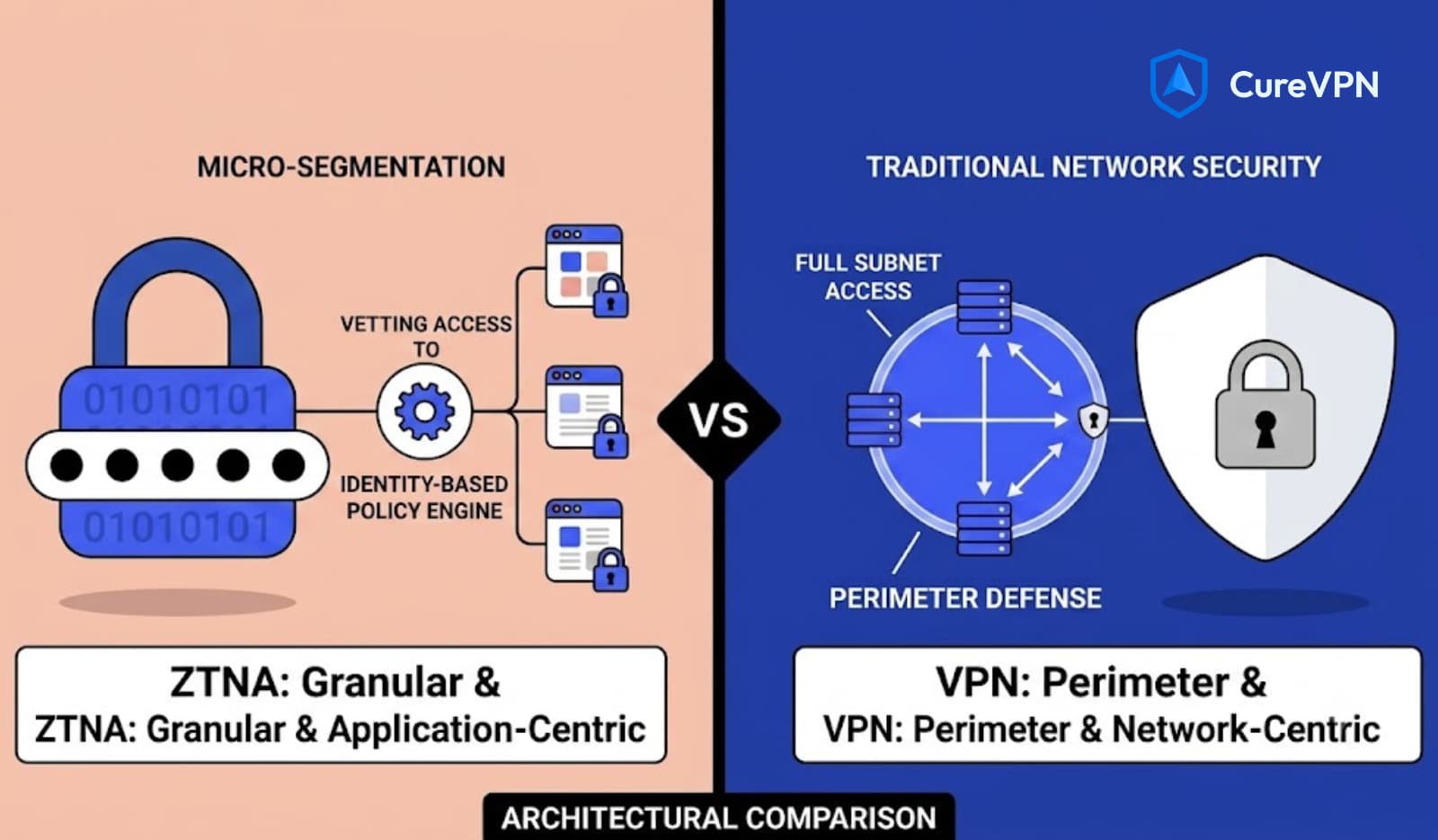
A VPN creates an encrypted tunnel that places a remote user on the corporate network, granting broad access after a single authentication. ZTNA (Zero Trust Network Access) grants per-application access instead — verifying identity, device posture, and context on every request while keeping the network itself invisible. VPNs excel at full-network access, legacy systems, and simplicity; ZTNA excels at limiting lateral movement, securing hybrid cloud, and protecting against stolen credentials. Most enterprises in 2026 run both.
That paragraph settles the definition question. The next four thousand words settle the harder one — which your organization should actually buy, run, or build.
What a VPN Actually Does (Enterprise Edition)
An enterprise VPN extends the corporate network to wherever the employee sits. The client encrypts traffic — typically over WireGuard, OpenVPN, or IPsec — and a concentrator or gateway terminates the tunnel inside the perimeter. Once connected, the user’s laptop behaves as if plugged into an office ethernet jack.
Three properties follow from that design, and every strength and weakness in this debate traces back to them:
- Network-level access. The tunnel delivers routes, not applications. File shares, printers, legacy client-server apps, thick-client databases, RDP, SSH — everything reachable on permitted subnets simply works, with no per-app integration effort.
- Authenticate once, trust thereafter. Classic deployments verify the user at connection time; afterward, the session persists on implicit trust. Modern enterprise VPN solution stacks bolt on MFA, posture checks, and session limits, but the trust model remains coarser than per-request verification.
- The gateway is a visible target. Concentrators listen on the public internet by necessity. When their firmware carries vulnerabilities — as the exploit waves against legacy appliances from several major vendors demonstrated through 2024 and 2025 — attackers gain a straight path inward.
None of this makes the tunnel obsolete. It makes the tunnel a specific tool: unbeatable for full-network semantics, riskier when deployed as the only control and left unpatched.
What ZTNA Actually Does
Zero Trust Network Access inverts the model. Rooted in the zero trust security model — “never trust, always verify,” a phrase coined at Forrester in 2010 and formalized in NIST SP 800-207 — ZTNA interposes a broker between users and applications:
- Per-application access, not network access. Users connect to App A and App B as named resources; the underlying network never appears in their routing table. Gartner’s definition centers on exactly this: an identity- and context-based logical boundary around applications, brokered to named entities.
- Continuous verification. Every request re-evaluates identity, device posture, location, and behavior. A session that passed at 9:00 can fail at 9:40 when the laptop’s disk encryption switches off.
- Application cloaking. Because apps sit behind the broker with no inbound listeners, unauthorized users — and internet scanners — see nothing. Lateral movement dies by design: compromising one session yields one application, not a subnet.
Deployment comes in agent-based flavors (software on managed endpoints, enabling deep posture checks) and agentless ones (browser-based access for contractors and BYOD). Google’s BeyondCorp initiative proved the architecture at scale years before the acronym existed; vendors such as Zscaler, Palo Alto Networks, Netskope, Cloudflare, and Fortinet now dominate the commercial market.
The honest caveat arrives just as quickly: ZTNA brokers applications, so anything that resists app-shaped access — legacy protocols, VoIP, peer-to-peer traffic, systems without modern APIs — gets awkward fast. MarketsandMarkets identifies legacy-application incompatibility as the primary adoption barrier across healthcare, government, and manufacturing, and that finding matches everything we see in the field.
Head-to-Head: Architecture, Security, UX, and Cost
| Dimension | Enterprise VPN | ZTNA |
|---|---|---|
| Access model | Network-level (routes and subnets) | Application-level (named resources) |
| Trust model | Verify at connect, trust the session | Verify continuously, per request |
| Attack surface | Public gateway; lateral movement possible after breach | Cloaked apps; lateral movement blocked by design |
| Stolen-credential blast radius | Potentially the whole permitted network | One application, until posture checks fail |
| Legacy & non-web systems | Excellent — anything routable works | Weak to moderate; often needs workarounds |
| Deployment effort | Days to weeks; well-understood | Weeks to months; per-app policy definition |
| User experience | Connect once; occasional slowness on backhauled traffic | Per-app SSO feel; no full-tunnel latency |
| Typical pricing | Per-gateway or modest per-user; self-hosting possible | $10–$30 per user/month, cloud-subscription |
| Compliance fit | Mature, familiar to auditors | Increasingly mandated (OMB M-22-09, NIS2 alignment) |
| Offline/site-to-site links | Native strength | Not the tool for the job |
Read the table honestly and a pattern emerges: the two technologies barely compete on half the rows. They answer different questions — “put me on the network” versus “let me use this application” — and enterprises asking both questions need both answers.
Where ZTNA Genuinely Wins
Credit where due — four scenarios favor zero trust decisively:
Hybrid and multi-cloud application estates. When your workloads span AWS, Azure, on-prem, and SaaS, backhauling everything through a VPN concentrator adds latency and a chokepoint. A broker-based modern remote access solution applies one policy framework across all of it, which is why secure remote access for hybrid teams has become ZTNA’s defining use case.
Third parties, contractors, and BYOD. Handing a contractor VPN credentials means handing them network presence. Agentless ZTNA scopes them to exactly the two applications their statement of work mentions — and revokes cleanly on the end date.
Containing stolen credentials. Phished VPN credentials historically opened subnets; phished ZTNA credentials open one cloaked app until the device posture check fails. With credential abuse remaining a top breach vector in the Verizon DBIR year after year, that blast-radius difference is the strongest argument zero trust owns.
Compliance regimes that mandate it. US federal agencies operate under OMB M-22-09’s zero trust requirements; NIS2 pushes European entities the same direction. When the auditor’s framework says “zero trust architecture,” the VPN vs zero trust architecture debate is settled by paperwork, not merit.
Where VPNs Still Win
Now the rows the ZTNA pitch decks skip:
Anything that isn’t an app. Site-to-site links between offices and data centers, full-subnet access for network engineers, legacy client-server software, industrial control systems, VoIP, and file protocols all want routes, not brokers. Enterprises in manufacturing, healthcare, and government keep VPNs for precisely these workloads — the same legacy-compatibility barrier MarketsandMarkets flags against ZTNA adoption.
Small teams and simplicity budgets. A ten-person company can deploy a hardened business VPN in an afternoon for a fraction of ZTNA’s per-user subscription. Zero trust’s policy engine earns its cost at scale and complexity; below that threshold, it is ceremony. Choosing a well-architected business VPN with MFA and modern protocols covers a small team’s realistic threat model at a tenth of the spend.
Privacy, egress, and the entire consumer universe. ZTNA protects access to your apps; it does nothing for encrypting general internet traffic, protecting remote workers on hostile Wi-Fi, or serving the 1.75 billion consumers who use VPNs for privacy, streaming, and gaming. That market keeps compounding regardless of enterprise architecture fashions — a point we return to below, because it matters enormously for anyone building in this space.
Sovereignty and self-hosting. Regulated and government buyers who must keep the control plane on their own soil can self-host VPN infrastructure end to end. Cloud-delivered ZTNA, by contrast, routes your access decisions through someone else’s broker.
The “VPN Is Dead” Myth, Examined
The obituary rests on one genuine fact and two sleights of hand.
The genuine fact: unpatched, legacy VPN appliances are a real and worsening attack vector — the DBIR’s 34 percent jump in edge-device exploitation is not marketing. Concentrators running years-old firmware deserve every criticism they receive.
Sleight of hand one: equating those appliances with VPN technology itself. A modern deployment — WireGuard-based, automatically patched, MFA-enforced, segmented, monitored — shares a name with a 2015 concentrator and little else. Condemning tunnels because old gateways go unpatched is like declaring web servers dead because someone found an unpatched IIS box.
Sleight of hand two: ignoring market arithmetic. ZTNA’s $1.34 billion (2025) is growing fast at a 25.5 percent CAGR, yet the VPN market stands at $86 billion in 2026 and continues expanding — because consumer privacy, prosumer use, SMB remote access, and site-to-site networking never belonged to the enterprise-remote-access story ZTNA is rewriting. Gaming communities alone sustain an entire product category: players comparing options for the best VPN for gaming, debugging routes with guides like can a VPN increase my ping, tuning transports via TCP vs UDP VPN ports, and reading best gaming VPN roundups are all VPN demand that zero trust cannot address even in principle. The same holds for censorship circumvention, where obfuscation layers like the Shadowsocks VPN protocol solve problems no application broker touches.
The accurate statement, then: legacy enterprise VPN concentrators are being displaced — Gartner projected that by 2025, 70 percent of new remote-access deployments would choose ZTNA, up from under 10 percent in 2021 — while VPN technology overall diversifies and grows. Buyers who grasp that distinction stop asking “which one survives?” and start asking “which workloads go where?”
The Buyer’s Decision Matrix
Match your profile; the answer usually writes itself.
| Your Profile | Recommended Model | Reasoning |
|---|---|---|
| Startup / team under ~25 | Modern business VPN | ZTNA’s cost and policy overhead exceed the threat model; a hardened tunnel with MFA covers it |
| SMB, 25–250, mostly SaaS | VPN now, ZTNA for crown jewels | Broker the 2–3 sensitive internal apps; tunnel the rest |
| Mid-market, hybrid cloud | ZTNA-led hybrid | Per-app access for the app estate; retain VPN for site-to-site and legacy |
| Enterprise, regulated (BFSI, health, gov) | Formal zero trust program + VPN enclave | Compliance mandates drive ZTNA; legacy and OT systems keep tunnels |
| Heavy OT / manufacturing / field ops | VPN-primary, ZTNA where apps allow | Legacy-protocol reality outweighs architecture fashion |
| Third-party-heavy access (contractors, vendors) | Agentless ZTNA immediately | Scoped, revocable, no network presence — the clearest ZTNA win |
| Distributed-first tech company | Best VPN alternative for enterprises: full ZTNA/SASE | Cloud-native estate, no legacy anchor, posture-rich endpoints |
Two notes keep the matrix honest. First, “hybrid” is not a compromise; it is the correct architecture for most organizations above fifty people, because their workload mix genuinely spans both access models. Second, whichever side leads, the losing model rarely disappears — it gets scoped to what it does best.
Migration Reality: How Hybrid Deployments Actually Work
Vendors sell rip-and-replace; practitioners run coexistence. The pattern that works, in four moves:
- Inventory by access shape. Classify every resource as app-shaped (web, SSH-to-known-hosts, RDP-to-named-machines) or network-shaped (legacy protocols, discovery-dependent tools, site-to-site). The split — not the vendor demo — determines your end-state.
- Broker the crown jewels first. Move the highest-value, most app-shaped systems behind ZTNA: code repositories, admin panels, finance systems, customer data apps. You buy maximum blast-radius reduction for minimum policy effort.
- Shrink and harden the tunnel. The VPN stops being the front door and becomes an enclave: modern protocols, aggressive patching, MFA, and routes narrowed to the network-shaped remainder. Shrinking scope is itself a security upgrade — a smaller permitted subnet means a smaller post-breach playground.
- Retire by attrition, not deadline. As legacy systems modernize or die, their VPN routes go with them. Some never will, and that is fine; a well-run tunnel serving three industrial systems is not technical debt. It is fit-for-purpose engineering.
Budget honestly for the overlap period: you will run two access stacks, two support runbooks, and two audit narratives for at least a year. Organizations that pretend otherwise ship the migration twice.
What the Shift Means for VPN Builders
Readers on the building side — founders, developers, resellers — should read the ZTNA story as market segmentation, not market obituary.
Enterprise remote access is consolidating around zero trust and SASE platforms, which raises the bar for anyone pitching a traditional concentrator into large accounts. Enterprise VPN development still thrives, but increasingly as ZTNA-adjacent engineering: identity integration, posture APIs, per-app policy — the skills transfer more than the pitch decks admit.
Consumer, prosumer, SMB, and specialty markets, meanwhile, remain wide open and growing. Privacy products, gaming-optimized services, censorship circumvention, and small-business remote access all run on tunnel technology ZTNA never addresses. For entrepreneurs, that is precisely where white label VPN development earns its economics: launching a branded service on proven infrastructure in weeks, targeting audiences zero trust structurally cannot serve. The build-versus-buy math we cover in our VPN development pillar — custom VPN development running $150K+, white label launches at a tenth of that — tilts further toward white label as the enterprise segment professionalizes, and questions like how much does VPN development cost increasingly answer themselves by segment: build custom only where the tunnel is the moat, buy VPN development services or white label infrastructure everywhere else. Just remember the obligations that come with the shortcut — a proper white label VPN compliance checklist covering privacy law, app-store rules, and payment processing remains yours regardless of whose servers you rent. VPN app development for these segments, done well, is a growth business wearing a “legacy” label it never deserved.
Expert Insights from the Cure VPN Team
Field observations from years of running tunnels while the zero trust wave rose around us:
Insight 1: The DBIR numbers indict patching, not protocols. Every VPN-appliance breach we have post-mortemed in the news cycle shared one trait: firmware months or years behind. Our infrastructure auto-patches and runs modern protocol stacks precisely because the tunnel’s security lives in operations, not in the acronym. Buyers should interrogate patch cadence before architecture philosophy.
Insight 2: ZTNA pilots stall on the app inventory, not the technology. Two partner organizations we advised began zero trust migrations with vendor-quoted six-week timelines. Both spent quarter one simply discovering what applications existed and who used them. The broker was never the bottleneck; the map was. Start the inventory before the procurement.
Insight 3: Contractors are the ideal first ZTNA workload. When a partner moved third-party access from VPN credentials to agentless brokered apps, offboarding went from a ticket queue to a checkbox — and their next security questionnaire visibly impressed an enterprise customer. Small scope, visible win, real risk reduction.
Insight 4: The shrunken tunnel outperforms the abandoned one. An organization that “replaced” its VPN but quietly kept the old concentrator for two legacy systems — unpatched, unmonitored, forgotten — built the exact backdoor the DBIR warns about. The teams that succeed treat the residual VPN as a first-class product: modern stack, narrow routes, full monitoring. Half-retired infrastructure is the most dangerous kind.
Insight 5: Consumer demand never blinked. Through every “VPN is dead” news cycle since 2021, consumer and SMB tunnel usage in our world only grew — privacy regulation, streaming, gaming, and remote work kept compounding. Builders who confused enterprise architecture headlines with their own market missed years of growth. Segment awareness is strategy.
Statistics and Data: The 2026 Remote-Access Market
Numbers worth citing, with sources named:
- The ZTNA market reaches $1.34 billion in 2025 and is projected to hit $4.18 billion by 2030 — a 25.5 percent CAGR. (MarketsandMarkets)
- North America holds 42.4 percent of ZTNA revenue, the largest regional share. (MarketsandMarkets)
- Gartner forecast that by 2025, at least 70 percent of new remote-access deployments would use ZTNA rather than VPN, up from under 10 percent in 2021. (Gartner)
- Meanwhile, the overall VPN market stands at $86 billion in 2026, en route to a projected $182 billion by 2030 — roughly sixty times ZTNA’s size, driven by consumer, SMB, and infrastructure segments. (The Business Research Company)
- 1.75 billion people worldwide use a VPN — about one in three internet users. (VPNpro)
- Verizon’s 2025 DBIR recorded a 34 percent increase in vulnerability exploitation targeting edge devices and VPN appliances, the strongest empirical argument for modernizing or scoping legacy gateways. (Verizon Data Breach Investigations Report)
- Zero trust mandates are regulatory reality: NIST SP 800-207 defines the architecture, OMB M-22-09 binds US federal agencies, and NIS2 pushes European entities toward zero trust principles. (NIST; OMB; EU)
- Legacy-application incompatibility remains ZTNA’s chief adoption barrier, particularly across healthcare, government, and manufacturing. (MarketsandMarkets)
One synthesis sentence, quotable on purpose: enterprise remote access is migrating to zero trust while the broader VPN economy keeps growing — the two facts contradict marketing narratives, not each other.
Common Buying Mistakes
- Framing it as either/or. The workload mix, not the vendor pitch, decides — and mixed workloads mean mixed architecture.
- Buying ZTNA before inventorying applications. The broker deploys in days; the app map takes a quarter. Sequence accordingly.
- Judging VPN technology by unpatched appliances. Interrogate patch cadence and protocol stack; “VPN” spans a decade of very different engineering.
- Forgetting the workloads that aren’t apps. Site-to-site, OT, legacy protocols, and VoIP will still exist after the ZTNA rollout — plan their home.
- Leaving the residual VPN half-retired. Unmonitored leftover concentrators are the breach pattern, not tunnels per se.
- Ignoring per-user subscription math at scale. $10–$30 per user per month compounds; model three-year TCO against self-hosted alternatives before signing.
- Assuming ZTNA covers general internet privacy. It brokers access to your apps; hostile-Wi-Fi protection and egress privacy remain tunnel jobs.
- For builders: reading enterprise headlines as consumer forecasts. The segments diverge; strategy should too.
- Skipping the coexistence budget. Two stacks, two runbooks, at least a year — pretend otherwise and pay twice.
- Letting compliance vocabulary pick the tool. Map the control objectives first; several are satisfiable by a well-run tunnel plus segmentation.
Best Practices for Remote-Access Strategy
- Classify resources by access shape — app-shaped versus network-shaped — before evaluating any vendor.
- Lead with the clearest win: contractor and third-party access moves to agentless ZTNA first, almost always.
- Treat the remaining VPN as a product: modern protocols, automatic patching, MFA, narrow routes, full logging.
- Verify continuously wherever possible, whichever transport carries the session — posture checks and short-lived credentials are architecture-agnostic virtues.
- Model three-year TCO honestly, including coexistence overhead, per-user subscriptions, and the engineering time per brokered app.
- Demand evidence from every vendor: patch SLAs and audit history from VPN providers; PoP coverage, legacy-app answers, and uptime from ZTNA brokers.
- Revisit the split annually. Applications modernize, workloads shift cloudward, and yesterday’s network-shaped resource becomes tomorrow’s brokered app.
Frequently Asked Questions
What is the difference between ZTNA and VPN?
A VPN grants network-level access through an encrypted tunnel after a single authentication, while ZTNA grants per-application access with continuous verification of identity, device posture, and context. VPNs deliver routes; ZTNA delivers named applications and keeps the network invisible.
Is ZTNA replacing VPN?
In new enterprise remote-access deployments, largely yes — Gartner projected 70 percent would choose ZTNA by 2025, up from under 10 percent in 2021. Across the broader market, no: the $86 billion VPN industry (consumer privacy, SMB access, site-to-site, gaming, circumvention) addresses needs ZTNA does not touch.
Is ZTNA more secure than a VPN?
For protecting enterprise applications against stolen credentials and lateral movement, generally yes — per-app brokering and continuous verification shrink the blast radius dramatically. A modern, patched, MFA-enforced VPN remains secure for its proper jobs; the DBIR’s exploited appliances were overwhelmingly legacy and unpatched.
What is Zero Trust Network Access in simple terms?
ZTNA is security that treats every access request as unproven: instead of trusting anyone inside the network, it checks who you are, what device you’re on, and whether you should reach that specific application — every time, for every app.
Can ZTNA and VPN work together?
Yes, and most enterprises above mid-size run exactly that hybrid: ZTNA brokers the app-shaped, high-value systems, while a scoped, hardened VPN serves site-to-site links, legacy protocols, and network-shaped workloads.
What does ZTNA cost compared to a VPN?
Cloud-delivered ZTNA typically runs $10–$30 per user per month, while enterprise VPNs range from modest per-user licensing to self-hosted deployments with mostly fixed costs. At small scale the VPN is dramatically cheaper; at large scale the comparison depends on breach-risk reduction and administrative savings.
What is the best VPN alternative for enterprises?
For cloud-native organizations with app-shaped estates, a full ZTNA or SASE platform (vendors include Zscaler, Palo Alto Networks, Netskope, and Cloudflare) is the strongest VPN alternative. Organizations with legacy, OT, or site-to-site needs should adopt a hybrid rather than a wholesale alternative.
Does ZTNA protect general internet browsing?
No. ZTNA brokers access to your organization’s applications; it does not encrypt general internet traffic or protect users on hostile networks. Egress privacy and public-Wi-Fi protection remain VPN functions, which is why the two technologies coexist even in zero trust shops.
Why do attackers target VPN appliances?
Internet-facing gateways with delayed patching offer a direct route into flat networks — Verizon’s 2025 DBIR measured a 34 percent jump in exactly this exploitation. The remedies are operational (aggressive patching, modern stacks, MFA, narrow routes) and architectural (scoping or brokering what the gateway exposes).
Is a VPN still worth it for small businesses?
Usually, yes. Below roughly 25 users with a mostly-SaaS footprint, a hardened business VPN with MFA covers the realistic threat model at a fraction of ZTNA’s subscription and policy overhead. Reassess as headcount, contractors, and internal applications grow.
What is NIST SP 800-207?
NIST Special Publication 800-207 is the US government’s formal definition of zero trust architecture — the principles (continuous verification, least privilege, assumed breach) that ZTNA products implement. OMB M-22-09 mandates federal agencies align with it.
Does the ZTNA shift kill the VPN business?
It resegments it. Enterprise remote access consolidates around zero trust, while consumer privacy, gaming, SMB, circumvention, and white label markets — the majority of the $86 billion industry — continue growing on tunnel technology. Builders should pick segments deliberately rather than mourning one of them.
What should I migrate to ZTNA first?
Third-party and contractor access, followed by high-value app-shaped systems (repositories, admin panels, finance tools). Both deliver visible risk reduction quickly while the longer application inventory proceeds.
Conclusion: Buy for Your Workloads, Not the War
Strip away two marketing departments’ worth of noise and the ZTNA vs VPN question resolves into something almost boring: match the access model to the access shape. App-shaped, high-value, third-party-touched workloads belong behind a zero trust broker. Network-shaped, legacy, site-to-site, and egress-privacy workloads belong in a modern, hardened tunnel. Most organizations own both shapes, so most organizations should run both models — deliberately, with the residual VPN treated as a product rather than a leftover.
The market data supports the peace treaty. Zero trust is winning new enterprise deployments exactly as Gartner predicted, and the VPN economy is simultaneously larger and faster-growing than ever. Both facts are true; only the slogans conflict.
Key Takeaways
- VPNs grant networks; ZTNA grants applications — the entire debate unpacks from that one architectural difference.
- ZTNA’s decisive wins: stolen-credential containment, contractor access, hybrid-cloud estates, and zero-trust compliance mandates.
- VPN’s enduring wins: legacy and non-app workloads, site-to-site, small-team economics, self-hosting sovereignty, and all egress privacy.
- The “dead VPN” is specifically the unpatched legacy concentrator — a patching indictment, not a protocol one.
- Hybrid is the honest end-state for most buyers: broker the crown jewels, shrink and harden the tunnel, retire by attrition.
- For builders, the shift is segmentation: enterprise consolidates around ZTNA while consumer, SMB, and white label tunnel markets keep compounding.
Whichever Side of the Tunnel You’re On — Cure VPN Builds It Right
Modern infrastructure is the answer to every legitimate criticism in this debate, and modern infrastructure is what Cure VPN runs: WireGuard-first stacks, automatic patching, MFA and posture-aware access, RAM-only servers, and audit-ready architecture. Businesses get a hardened tunnel that belongs in a zero trust world; entrepreneurs get white label infrastructure for the consumer and SMB segments that keep growing straight through the ZTNA era.
Talk to the Cure VPN team for a free consultation — whether you need a business VPN engineered to modern standards or a white label launch into the markets zero trust will never serve. The remote-access world is resegmenting. Build your position on infrastructure designed for what 2026 actually rewards.