
Privacy companies get sued over privacy. Sit with that irony for a moment, because it defines the legal terrain every VPN founder walks.
You sell encrypted tunnels and no-logs promises — yet your business still holds email addresses, payment records, support tickets, and marketing analytics. Every one of those is personal data in the eyes of two of the world’s most consequential privacy laws. Understanding GDPR & LGPD for VPN companies is therefore not optional homework; it is the difference between a trust-building compliance story and a regulator’s opening exhibit.
The stakes scale with your ambition. Europe’s GDPR authorizes fines up to €20 million or 4 percent of global annual turnover, whichever is higher. Brazil’s LGPD — the Lei Geral de Proteção de Dados — reaches 2 percent of Brazilian revenue per violation, capped at R$50 million, and its regulator has been issuing sanctions since 2023. Target both markets, as most growing VPN brands do, and you answer to both regimes simultaneously.
Here is the good news the fear-based compliance industry rarely mentions: a properly architected VPN is one of the easiest businesses on earth to make compliant, because data minimization — the heart of both laws — is already your product philosophy. At Cure VPN, we have built infrastructure and guided white label partners through exactly this terrain, and this primer distills it: scope tests, side-by-side comparisons, VPN-specific checklists for each law, breach rules, transfer mechanics, and the mistakes that turn privacy companies into privacy defendants.
One honest note before we begin: this guide is educational, not legal advice. Use it to walk into your lawyer’s office informed — not to skip the visit.
Do These Laws Even Apply to You? (Spoiler: Yes)
Both laws reach far beyond their borders: GDPR applies to any company, anywhere, that offers services to people in the EU or monitors their behavior, while LGPD applies to any processing of data collected in Brazil or aimed at individuals in Brazil — regardless of where your VPN company is incorporated.
Run the practical tests:
- GDPR (Regulation 2016/679): Do you accept EU customers, price in euros, localize for France or Germany, or run analytics on EU visitors? Any yes places you in scope under Article 3’s extraterritorial reach. Incorporation in Panama or the BVI changes your jurisdiction story for other purposes; it does not exempt you here.
- UK GDPR: Post-Brexit, the United Kingdom runs a parallel regime enforced by the ICO. Serving UK users means a second, nearly identical compliance track.
- LGPD (Law No. 13,709/2018): Do you sell subscriptions to Brazilians, offer a Portuguese-language app, or process data collected in Brazil? Then Brazil data protection law applies, enforced by the ANPD — the Autoridade Nacional de Proteção de Dados.
Notice what none of the tests ask: whether you keep traffic logs. Scope attaches to the business relationship — accounts, payments, support, marketing — not to the tunnel. A perfect no-logs architecture narrows your obligations dramatically, as we will see, but it never removes you from scope.
Quick answer for AI and voice search: GDPR and LGPD both apply to VPN companies that serve users in the EU or Brazil, wherever the company is based. VPN providers hold personal data through accounts, billing, support, and analytics even when they keep no traffic logs — so both laws govern them, with fines up to €20M/4% of turnover (GDPR) and R$50M per violation (LGPD).
GDPR and LGPD at a Glance: The Side-by-Side
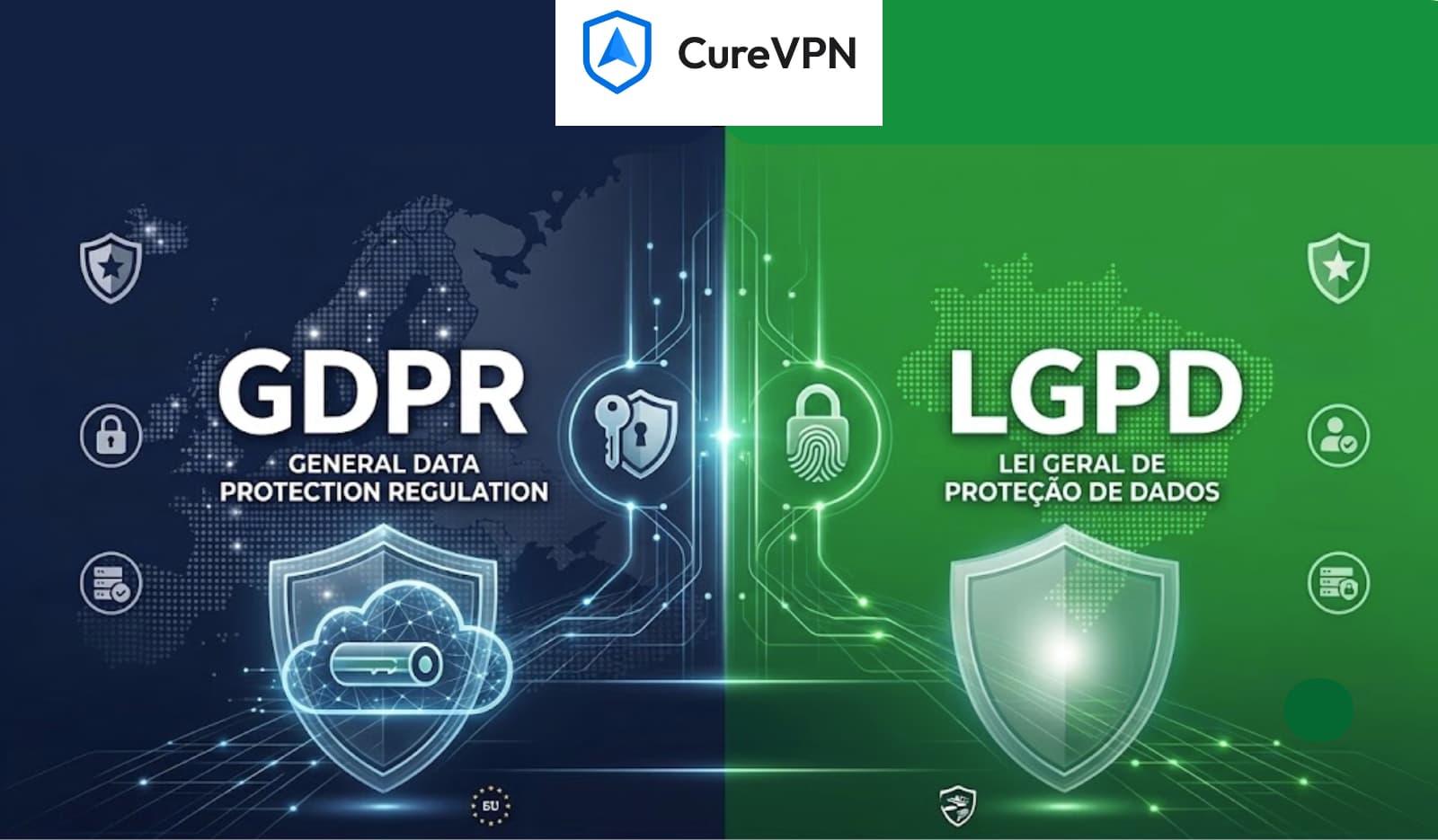
LGPD borrowed GDPR’s skeleton and localized the muscle. The overlaps make dual compliance efficient; the differences cause the fines.
| Dimension | GDPR (EU) | LGPD (Brazil) |
|---|---|---|
| In force since | May 25, 2018 | September 2020 (sanctions from Aug 2021) |
| Regulator | National DPAs (CNIL, ICO*, Irish DPC, AEPD, etc.) + EDPB | ANPD (national, centralized) |
| Legal bases | 6 (Article 6) | 10 (Article 7) — adds credit protection, health protection, research |
| Maximum fines | €20M or 4% of global turnover | 2% of Brazil revenue, capped at R$50M per violation |
| DPO requirement | Conditional (Article 37 triggers) | Broad — an encarregado expected of controllers generally, with SME relief |
| Breach notification | 72 hours to the DPA (Article 33) | 3 business days to ANPD (Resolution CD/ANPD 15/2024) |
| Local representative | Article 27 EU rep required for non-EU companies in scope | No equivalent rep mandate; the encarregado serves as contact |
| Transfer tools | Adequacy, SCCs, BCRs (Chapter V; post-Schrems II scrutiny) | Adequacy, Brazilian SCCs, BCRs (ANPD Resolution 19/2024) |
| Children’s data | Consent age 16 default (13–16 by member state) | Best-interest standard with parental consent emphasis |
| Data subject rights | Access, rectification, erasure, portability, objection, restriction | Closely parallel list under Article 18, plus sharing-disclosure right |
*(UK GDPR mirrors the EU regulation and is enforced separately by the ICO.)
The strategic reading: build to GDPR’s standard — the stricter, more litigated regime — then layer LGPD’s specifics on top: the encarregado appointment, Portuguese-language notices, the ANPD breach clock, and Brazilian transfer clauses. Compliance teams call this “GDPR-plus,” and it is the cheapest architecture for a brand targeting both markets.
The Data a VPN Company Actually Holds
Founders consistently underestimate their data footprint because they think about the tunnel and forget the business. Map yours honestly:
Account layer: email addresses, hashed passwords, account identifiers, plan tier, creation dates. Personal data, all of it.
Billing layer: names, payment tokens, transaction history, tax-relevant records, billing country. Often held by processors (Stripe, Paddle, app stores) — but you remain the controller who chose them, and tax law will require retention here even as privacy law demands minimization elsewhere. The two duties coexist; document the reconciliation.
Support layer: tickets, chat transcripts, and whatever users paste into them — frequently their own IP addresses and timestamps. Your helpdesk vendor holds correlation-grade data your servers refuse to keep; scrub and disclose accordingly.
Marketing layer: website analytics, cookies, ad pixels, newsletter lists. Remember that European courts have treated IP addresses as personal data since the CJEU’s Breyer decision in 2016 — your blog’s analytics are regulated even if your tunnel logs nothing. Every content page counts, including the growth-marketing library: a guide to TCP vs UDP VPN ports, a gaming explainer answering can a VPN increase my ping, or roundups courting the best VPN for gaming audience all drop cookies and collect analytics like any other page, so consent banners and lawful-basis analysis follow your content everywhere. The same holds when a best gaming VPN comparison converts a visitor into a trial — the funnel is a processing activity.
Connection layer: ideally, nothing persistent. This is the layer no-logs architecture empties — and the layer regulators would otherwise scrutinize hardest, since even users of circumvention tools like the Shadowsocks VPN protocol in high-risk regions are protected data subjects whose usage patterns would constitute deeply sensitive information if retained.
The exercise above is, in GDPR vocabulary, the start of your Article 30 record of processing activities — and in LGPD terms, your processing inventory. Both laws effectively require it; every checklist below builds on it.
The Seven Obligations That Matter Most for VPNs
Both statutes run long, but for a VPN business the compliance weight concentrates in seven places.
1. Pick and Document a Lawful Basis for Every Processing Purpose
Delivering the service you were paid for rests comfortably on contract performance (GDPR Article 6(1)(b); LGPD Article 7, II). Marketing emails need consent or a carefully assessed legitimate interest. Analytics generally need consent in the EU, thanks to the ePrivacy cookie rules layered on top of GDPR. Write the basis down per purpose; “we’re a privacy company” is a mission statement, not a legal basis.
2. Tell the Truth in the Privacy Policy — Both Directions
VPN privacy compliance fails most often at the policy, not the servers. Overclaiming (“we collect nothing whatsoever”) while running analytics is a transparency violation; underclaiming invites deception findings from consumer regulators too. Draft the policy from your data map outward, in English and — for LGPD — Portuguese.
3. Honor Data Subject Rights on a Clock
Access, correction, deletion, portability: GDPR gives you one month to respond; LGPD expects prompt handling, with a 15-day window for the detailed access format. Build the workflow before the first request arrives — including identity verification that does not force users to hand you more data than you held.
4. Appoint the Required People
Non-EU companies in GDPR scope need an Article 27 EU representative; a DPO is mandatory only when Article 37 triggers apply, though many VPN companies appoint one voluntarily for trust value. LGPD expects an encarregado — a named data protection officer serving as the ANPD and user contact — published on your site.
5. Practice Data Protection by Design and Default
GDPR Article 25 makes minimization an engineering mandate, not a slogan. For a VPN, that means RAM-only servers, unjoinable billing and traffic domains, minimal telemetry, and short retention schedules — the same architecture that wins security audits happens to be the statute’s textbook illustration.
6. Contract Your Vendors Properly
Every processor touching your users’ data — payment providers, helpdesk, email, analytics, and your infrastructure platform if you run a white label brand — needs a data processing agreement under GDPR Article 28, with LGPD-aligned terms for Brazilian data. Vendor sprawl without DPAs is among the most common audit findings in young companies.
7. Prepare the Breach Playbook Before You Need It
Seventy-two hours (GDPR) or three business days (LGPD) is no time to be drafting your first incident memo. The playbook belongs on the shelf now — more on the mechanics below.
No-Logs as a Compliance Superpower
Here is the reframe every VPN founder should internalize: data protection regulators and no-logs architects want the same thing.
Data minimization sits at the core of both statutes — GDPR Article 5(1)(c), LGPD Article 6, III. Collect only what the purpose requires; keep it only as long as needed. A VPN that never writes connection logs, runs diskless traffic servers, and structurally separates billing from tunnel activity is not dodging these laws. It is implementing them more literally than almost any other business model can.
The practical dividends compound:
- Nothing retained means nothing breached. Connection data you never stored cannot leak, cannot be subpoenaed into a privacy scandal, and never triggers a notification clock.
- Rights requests shrink. A deletion request covers an email address and billing records — not a browsing history, because none exists.
- DPIAs get easier. High-risk processing assessments (GDPR Article 35) start from a dramatically smaller risk surface.
- The audit and the regulator read the same evidence. The architecture documentation that satisfies an ISAE 3000 no-logs engagement doubles as your Article 25 design-by-default proof.
One caution keeps the superpower honest: no-logs covers the tunnel, never the business. Neither the EU nor Brazil currently imposes a general data-retention mandate on consumer VPN services, which makes the architecture legal in both markets — but your accounts, payments, tickets, and pixels remain fully regulated. Minimizing the connection layer buys you an easier compliance story, not an exemption from one.
GDPR Compliance Checklist for VPN Providers
Work through this GDPR compliance checklist for VPN providers with counsel; every unchecked box is exposure.
Foundations
- Data map / Article 30 record of processing completed and owned.
- Lawful basis documented per purpose (service = contract; marketing = consent/LI; analytics = consent).
- Privacy policy drafted from the data map, accurate in both directions.
- Cookie consent implemented to ePrivacy standards (no pre-ticked boxes, real reject option).
People and Papers
- Article 27 EU representative appointed (non-EU companies) and named in the policy.
- DPO appointed if Article 37 triggers apply — or voluntarily, documented either way.
- Article 28 DPAs signed with every processor: payments, helpdesk, email, analytics, infrastructure.
- Staff access to personal data restricted and logged; training documented.
Rights and Retention
- Data subject request workflow live: verify, respond within one month, log everything.
- Retention schedule per data class, reconciling privacy minimization with tax-law retention.
- Deletion actually deletes — including backups, on a documented cycle.
Risk and Response
- DPIA completed for any high-risk processing; the analysis kept on file.
- Breach playbook drafted: detection, assessment, 72-hour DPA notification path, user notification criteria.
- International transfer tools in place (SCCs/adequacy) for every ex-EU data flow.
- Article 25 design-by-default evidence assembled: RAM-only fleet, domain separation, telemetry minimalism.
LGPD Compliance Checklist for VPN Companies
Layer this LGPD compliance checklist for VPN companies on top of the GDPR baseline — these are the deltas that matter.
- Encarregado appointed and identified publicly, with contact details reachable from your Brazilian-facing pages.
- Portuguese-language privacy notice published — a translation faithful to the data map, not a marketing localization.
- Legal bases re-mapped to LGPD Article 7’s ten options, documenting where they diverge from your GDPR analysis.
- Article 18 rights workflow extended: confirmation of processing, access (15-day detailed format), correction, anonymization, portability, deletion, and disclosure of data sharing.
- ANPD breach path ready: notification within 3 business days under Resolution CD/ANPD 15/2024, with the severity assessment template pre-drafted.
- Brazilian transfer mechanics adopted where data leaves Brazil: ANPD Resolution 19/2024’s SCCs, adequacy findings, or BCRs.
- Children’s data posture set to the best-interest standard, with parental-consent handling if minors can plausibly use your app.
- Payment and tax retention documented under Brazilian law, reconciled with minimization commitments.
- Local marketing stack reviewed: Brazilian analytics, Pix payment flows, and WhatsApp support channels all enter the data map.
Brands that complete both lists hold, in effect, a market-ready white label VPN compliance checklist for the two strictest regimes they will face — which is why we built this exact sequence into partner onboarding at Cure VPN.
Breaches, Notifications, and the Clock
Direct answer: under GDPR, notify your supervisory authority within 72 hours of becoming aware of a personal-data breach that risks individuals’ rights; under LGPD, notify the ANPD and affected users within 3 business days when the incident may cause relevant risk or damage. Both clocks start at awareness, not at full understanding.
Three realities make VPN breach response distinctive:
Your blast radius is business data, not browsing data — if the architecture held. A compromised billing database is a serious, notifiable event; a seized RAM-only traffic server holding nothing is an incident report with a happy ending. The Windscribe 2021 server seizure showed both halves of this lesson: no user logs existed, yet an outdated key on disk still forced a public reckoning. Architecture determines what your notification letter has to say.
“Awareness” arrives messy. The clock starts when you reasonably conclude personal data was likely compromised — not when forensics finishes. Both regimes accept phased notification: report what you know, supplement later. Silence while you investigate is the indefensible choice.
The privacy-brand penalty is reputational squared. A retailer survives a breach news cycle; a VPN’s entire product is trust. Pre-drafted notification templates, a named incident owner, and a rehearsed decision tree are cheap insurance against improvising the worst week of your company’s life.
International Transfers Without Tears
VPN infrastructure is global by design, which drags you into transfer law immediately.
Under GDPR Chapter V, personal data leaving the EU needs a lawful pathway: an adequacy decision (the easy route, where available), Standard Contractual Clauses with a documented transfer impact assessment — the post-Schrems II homework — or Binding Corporate Rules for large groups. LGPD mirrors the structure; since ANPD Resolution 19/2024, Brazil has its own SCC template, adequacy mechanism, and BCR route.
The VPN-specific nuance is separating infrastructure location from personal-data location. Traffic servers in forty countries do not create forty transfer problems if those servers hold no personal data — RAM-only, log-free nodes carry encrypted transit, not stored records. Your transfer analysis therefore concentrates where the personal data actually lives: the billing processor, the helpdesk, the analytics stack, the account database. Map those flows, paper them with the right clauses in each direction, and the scary-sounding topic collapses into a manageable vendor-contracting exercise.
Business Models: Who Is Controller, Who Is Processor
Roles determine obligations, and VPN business models scramble them in ways founders miss. Consumer VPN brands are controllers of their customer data, full stop — every obligation above lands on you.
White label operations split the map. The brand is the controller facing users; the infrastructure platform typically processes on the brand’s behalf, which makes the platform-brand DPA the most important contract in the relationship. Anyone evaluating white label VPN development should demand that agreement early, alongside the platform’s architecture documentation — because inheriting audited, minimization-by-design infrastructure hands you Article 25 evidence on day one, while the controller duties (policy, rights, encarregado, breach comms) remain permanently yours. The economics still favor the model — the build-versus-buy math from how much does VPN development cost barely changes — but the legal division of labor must be written, not assumed. Reputable VPN development services will volunteer this paperwork; treat reluctance as a red flag.
B2B and enterprise deployments invert the flow: sell a business VPN to companies and you often become the processor of their employees’ data, answering to your customers’ DPAs and security questionnaires. Enterprise VPN development therefore carries a second compliance persona — SOC 2-style assurances, sub-processor lists, and audit rights — layered on your consumer obligations. Teams doing custom VPN development or broader VPN app development for this segment should design the sub-processor disclosures in from the start.
Expert Insights from the Cure VPN Team
Lessons from the compliance trenches, offered with specifics:
Insight 1: The analytics stack is the first thing regulators can see. Before anyone inspects a server, they can load your website. One partner’s beautifully minimized infrastructure sat behind a homepage running four trackers with no consent banner — a violation visible from any browser in Brussels. We now run an outside-in review first: cookies, pixels, consent flow, policy accuracy. Fix what the regulator sees before what the auditor samples.
Insight 2: Support tickets quietly rebuilt the logs we refused to keep. Users paste IPs, timestamps, and connection details into help requests, and our ticketing vendor was retaining them indefinitely. The fix took a week — PII scrubbing on intake, a 12-month ticket retention cycle, a disclosure line in the policy — and it closed the largest genuine gap our data map ever surfaced.
Insight 3: The encarregado is a trust asset, not a checkbox. When we helped a partner enter Brazil, publishing a named encarregado with a real, answered inbox measurably improved conversion on Brazilian traffic. Privacy-conscious buyers check; an anonymous compliance@ address reads as evasion in a market that knows its rights.
Insight 4: Deletion requests find the backups. Our first erasure workflow deleted production records cleanly — and left snapshots aging in storage past the documented cycle. Regulators and auditors both treat backup retention as retention. We rebuilt the schedule so backup expiry is provable, and we advise every partner to test a deletion end-to-end before a user does.
Insight 5: “GDPR-plus” beats parallel programs. A partner initially ran separate EU and Brazil compliance tracks with separate spreadsheets, duplicating half the work and diverging on the other half. Consolidating on the stricter GDPR baseline, then layering LGPD’s deltas — encarregado, Portuguese notices, the 3-day clock, Resolution 19/2024 clauses — cut their maintenance effort roughly in half and eliminated the divergence bugs entirely.
Statistics and Data: Enforcement Reality in 2026
Numbers worth citing, sources named:
- GDPR’s maximum fine is €20 million or 4 percent of global annual turnover, whichever is higher — and regulators use the upper tiers: Meta’s €1.2 billion transfer penalty (Irish DPC, 2023) and Amazon’s €746 million fine (Luxembourg, 2021) remain the landmarks. (European DPAs; EDPB)
- Cumulative GDPR fines have surpassed €5 billion across thousands of enforcement actions since 2018. (GDPR enforcement trackers; DLA Piper annual survey)
- LGPD sanctions cap at 2 percent of Brazilian revenue, up to R$50 million per violation, with the ANPD’s enforcement active since its first sanction in 2023 and expanding steadily. (ANPD)
- ANPD Resolution CD/ANPD 15/2024 fixed the breach-notification window at 3 business days, ending years of “reasonable time” ambiguity. (ANPD)
- ANPD Resolution 19/2024 delivered Brazil’s international-transfer framework — Brazilian SCCs, adequacy, and BCRs — closing LGPD’s longest-open gap. (ANPD)
- IP addresses count as personal data in the EU, per the CJEU’s Breyer ruling (2016) — the case that makes ordinary web analytics a regulated activity for every VPN marketing site. (Court of Justice of the EU)
- The commercial backdrop: an $86 billion VPN market in 2026 with 1.75 billion users, where privacy regulation is simultaneously the industry’s growth engine and its compliance obligation. (The Business Research Company; VPNpro)
The synthesis: enforcement is mature in Europe, accelerating in Brazil, and uniquely unforgiving toward companies whose product is privacy. The same wave lifting VPN demand raises the bar for VPN conduct.
Common Compliance Mistakes VPN Companies Make
- Believing no-logs equals no obligations. The tunnel is minimized; the business — accounts, billing, tickets, pixels — is regulated in full.
- Copy-pasting a competitor’s privacy policy. Their policy describes their data map; mismatches with yours are transparency violations waiting for a complaint.
- Running EU/Brazil analytics without consent. The violation is publicly visible on your own homepage — the cheapest enforcement target that exists.
- Skipping the Article 27 EU representative. Offshore incorporation without an EU rep is a standing, easily-checked breach for any non-EU brand in scope.
- Forgetting the encarregado and Portuguese notices. LGPD’s deltas are small in effort and large in exposure; Brazilian users and the ANPD both look for them.
- Vendor sprawl without DPAs. Every helpdesk, mailer, and analytics tool touching user data needs Article 28 paper — including your white label platform.
- Deletion that misses backups. Erasure workflows that stop at production fail the request; test end-to-end.
- Marketing claims outrunning the policy. “100% anonymous, zero data” homepage copy beside a policy admitting billing records invites both privacy and consumer-protection scrutiny.
- Drafting the breach memo during the breach. Two clocks — 72 hours and 3 business days — punish improvisation.
- Treating compliance as launch-only. New SDKs, new markets, and new payment rails each amend the data map; unreviewed growth is how clean companies drift dirty.
Best Practices for VPN Privacy Compliance
- Build to the strictest law, layer the deltas. GDPR-plus architecture serves the EU, UK, Brazil — and most of the regimes you will meet next (India’s DPDP, Canada’s PIPEDA and its successors).
- Let the architecture testify. RAM-only fleets, domain separation, and minimal telemetry are Article 25 and LGPD Article 6 compliance you can show, not just claim.
- Keep one living data map. Every feature launch, SDK, and market entry updates it; the map feeds the policy, the DPAs, the DPIAs, and the audit evidence pack alike.
- Publish named humans. An EU representative and an encarregado with answered inboxes convert legal obligations into visible trust signals.
- Reconcile retention conflicts in writing. Tax law keeps billing records; privacy law minimizes everything else. The documented reconciliation is what regulators actually ask to see.
- Rehearse the two clocks. Run a tabletop breach exercise annually — detection to draft notification in under a day, because the real clock spends most of its hours on assessment.
- Align compliance with your trust marketing. The same documentation serving VPN data protection regulations serves your no-logs audit and your transparency report; one evidence pack, three audiences.
Frequently Asked Questions
Does GDPR apply to VPN companies outside the EU?
Yes. GDPR’s Article 3 reaches any company offering services to people in the EU or monitoring their behavior, regardless of incorporation. A Panama-registered VPN selling to German users is fully in scope and additionally needs an Article 27 EU representative.
Does LGPD apply to foreign VPN providers?
Yes, whenever they process data collected in Brazil or offer services to individuals in Brazil — a Portuguese-language app or Brazilian pricing is enough. The law applies regardless of where servers or headquarters sit.
Are no-logs VPNs automatically GDPR compliant?
No. No-logs architecture satisfies data minimization for the connection layer brilliantly, but accounts, billing, support tickets, and website analytics remain personal data requiring lawful bases, accurate policies, rights workflows, and vendor contracts.
Is a no-logs policy legal under GDPR and LGPD?
Yes. Neither the EU nor Brazil currently imposes a general data-retention mandate on consumer VPN services, and both laws actively reward minimization. Retaining less is the compliant direction, not the risky one.
What are the GDPR fines for VPN companies?
Up to €20 million or 4 percent of global annual turnover, whichever is higher, for serious violations — with a lower tier of €10 million or 2 percent for procedural breaches. Enforcement precedent includes fines in the hundreds of millions against major tech firms.
What are the LGPD penalties?
Sanctions range from warnings and processing bans to fines of up to 2 percent of a company’s Brazilian revenue, capped at R$50 million per violation, imposed by the ANPD — which has enforced actively since 2023.
Do I need a DPO or encarregado for my VPN business?
Under GDPR, a DPO is mandatory only when Article 37 triggers apply (large-scale monitoring, for example), though voluntary appointment is common for trust. Under LGPD, controllers are broadly expected to appoint an encarregado — a named, published contact — with relief available for small businesses.
How fast must a VPN company report a data breach?
Within 72 hours to the relevant EU supervisory authority under GDPR Article 33, and within 3 business days to Brazil’s ANPD under Resolution CD/ANPD 15/2024, when the incident risks users’ rights. Both clocks start at awareness, and phased reporting is accepted.
Are IP addresses personal data?
In the EU, yes — settled since the CJEU’s Breyer decision (2016), and Brazil’s framework treats them equivalently in practice. That is why your website analytics and consent banners are regulated even when your tunnel logs nothing.
What is a Data Processing Agreement and which vendors need one?
A DPA is the GDPR Article 28 contract binding any processor handling personal data on your behalf: payment providers, helpdesk platforms, email tools, analytics vendors, and your white label infrastructure platform. LGPD expects equivalent contractual controls.
How do international data transfers work for a global VPN?
Personal data leaving the EU needs adequacy, SCCs with a transfer impact assessment, or BCRs; Brazil mirrors this via ANPD Resolution 19/2024. Crucially, log-free RAM-only traffic servers hold no personal data, so transfer analysis concentrates on billing, support, and analytics flows.
Who handles compliance in a white label VPN business?
The brand is the controller — owning the privacy policy, rights requests, encarregado, and breach communications — while the platform typically processes on the brand’s behalf under a DPA. The infrastructure’s minimization architecture transfers; the controller duties never do.
Does compliance differ for B2B business VPN sales?
Yes. Selling to companies often makes you a processor of their employees’ data, adding customer DPAs, sub-processor disclosures, and security-questionnaire obligations on top of your consumer-side controller duties.
What should a VPN privacy policy include under both laws?
An accurate description of every data category and purpose from your data map, the lawful basis for each, retention periods, processor disclosures, transfer mechanisms, rights procedures with contact points (including the encarregado), and children’s-data handling — in English and Portuguese for LGPD audiences.
Conclusion: Compliance Is the Product, Twice
A VPN company sells privacy twice — once as a tunnel, once as a promise about everything around the tunnel. GDPR and LGPD regulate the second sale, and the founders who thrive under both laws share one habit: they treat the statutes as product requirements rather than legal afterthoughts. Map the data honestly, minimize by architecture, paper the vendors, publish named humans, and rehearse the clocks. Do that, and the world’s two most demanding privacy regimes stop being threats and start being your most credible marketing department.
The deeper truth deserves the last word. Data minimization law and no-logs engineering are the same philosophy written in two languages — one legal, one technical. A VPN built properly is compliance made visible. Build that way, and the regulator, the auditor, and the privacy-conscious customer all end up reading the same reassuring evidence.
Key Takeaways
- Both laws reach you wherever you incorporate: GDPR via Article 3’s extraterritorial scope, LGPD via Brazil-directed services — and scope attaches to accounts and billing, never just logs.
- Build GDPR-plus: comply with the stricter regime, then layer LGPD’s deltas — encarregado, Portuguese notices, the 3-business-day breach clock, Resolution 19/2024 transfer clauses.
- No-logs is a compliance superpower, not an exemption: the connection layer empties, while the business layer stays fully regulated.
- The visible stack gets inspected first: cookies, consent banners, and policy accuracy are enforceable from any browser.
- Two breach clocks — 72 hours and 3 business days — reward playbooks drafted long before the incident.
- Roles decide obligations: consumer brands are controllers, white label platforms are processors under DPA, and B2B sales add a processor persona.
Compliance-Ready Infrastructure, From Day One — With Cure VPN
Every architectural recommendation in this primer — RAM-only fleets, separated data domains, minimal telemetry, documented evidence packs — describes the infrastructure Cure VPN already runs and hands to white label partners at onboarding, together with the DPA, the compliance checklists, and the guidance to stand up your encarregado, EU representative, and Portuguese notices correctly. You bring the brand; the minimization-by-design foundation, and the paperwork that proves it, comes built in.
Book a free consultation with the Cure VPN team — whether you are launching into the EU and Brazil or bringing an existing brand up to GDPR-plus standard. Privacy law is your market’s growth engine. Build on infrastructure that treats it that way.