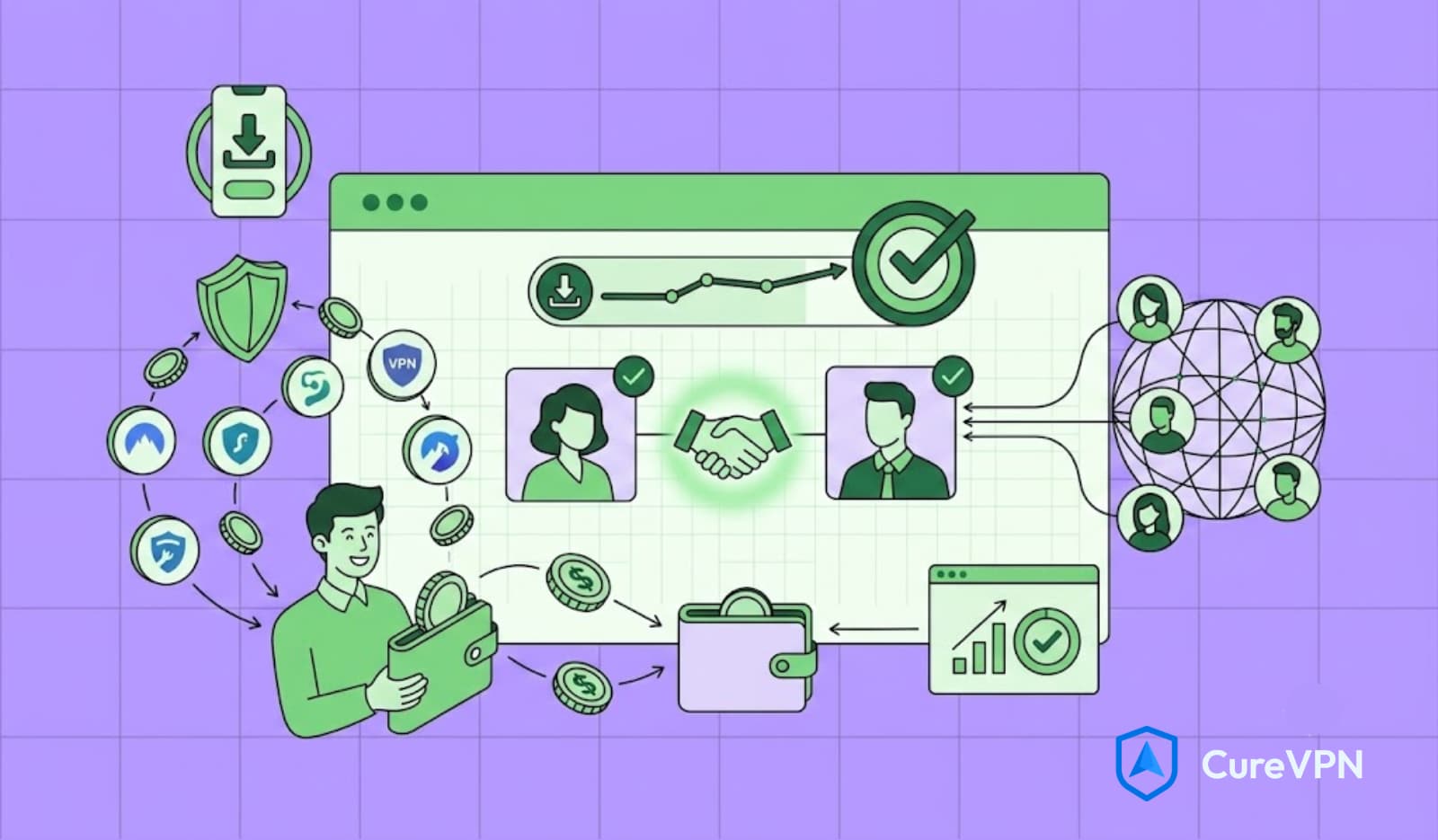

A VPN partner program is one of the most compelling business opportunities in the technology sector right now — and most people entering the space don’t realize how many different ways to participate actually exist. Some businesses want to resell an established VPN service under a revenue-sharing arrangement. Others want a fully branded product carrying their own company name. Some want affiliate commissions for traffic they already generate. A few want to go deeper — owning the entire customer relationship, the infrastructure, and the recurring subscription revenue.
All of these are legitimate paths. All of them sit under the broad umbrella of “VPN partnerships.” And in a global market projected to exceed $77 billion by 2026, with demand accelerating across every region from the United States to Brazil to India to Europe, the question isn’t whether a VPN partner model can work for your business. It’s which model fits your business — and how to evaluate the partner that makes it possible.
This guide breaks it all down completely.
What Is a VPN Partner Program?
A VPN partner program is a formal business arrangement in which a VPN provider grants another company or individual the right to sell, resell, or distribute VPN services — in exchange for a commission, revenue share, or margin on sales. Depending on the program tier, partners may sell the provider’s branded product, resell it under their own name, or launch a fully independent white-label VPN brand powered by the provider’s infrastructure.
The term “VPN partnership” covers a broader spectrum than most people initially recognize. It includes the blogger earning a $40 referral commission, the managed service provider bundling VPN access into its security stack, the startup launching its own branded consumer VPN app, and the telecom company integrating VPN-as-a-Service into its enterprise product line. Each of these is a different model with different economics, different responsibilities, and different revenue potential.
Consequently, the first decision any prospective VPN partner needs to make isn’t which provider to work with — it’s which partnership structure actually matches their business model.

The Four VPN Partnership Models Explained
Understanding these four structures clearly prevents the most common mistake in this space: choosing a model based on superficial appeal rather than genuine fit.
| Model | Who Sells It As | Revenue Source | Infrastructure Responsibility |
|---|---|---|---|
| Affiliate / Referral | Provider’s branded product | Commission per conversion | Provider |
| Reseller | Provider’s branded or co-branded product | Margin on subscriptions | Provider |
| White Label | Your own branded product | Full subscription revenue | Provider (behind the scenes) |
| Technology Partner / OEM | Integrated into your own product | Licensing or revenue share | Negotiated |
Each model represents a different trade-off between control, upfront investment, revenue potential, and operational complexity. Understanding where you sit on that spectrum makes every subsequent decision cleaner.
VPN Reseller Program — How It Works
A VPN reseller program gives businesses the right to purchase VPN subscriptions at wholesale pricing and resell them to their own customers at a markup. The provider continues to own the brand, manage the infrastructure, and handle core technical support. The reseller’s business centers on sales, customer acquisition, and account management.
Who VPN Reselling Works Best For
- Managed service providers (MSPs) bundling security services for small and medium businesses
- IT service providers adding VPN to an existing monthly security package
- Telecom companies offering VPN as an add-on to existing plans
- Digital agencies building recurring revenue alongside project-based work
The Economics of VPN Reselling
Margins in reseller programs typically range from 20–50% of retail pricing depending on volume commitments and program tier. At the low end, a reseller selling 100 subscriptions at $8/month retail with a 30% margin earns $240/month in recurring revenue. At 1,000 subscriptions, that same margin produces $2,400/month — with no infrastructure costs, no technical maintenance, and no customer support overhead beyond basic account management.
Furthermore, because VPN subscriptions are inherently recurring, the compounding effect is meaningful: every customer acquired adds permanently to the monthly revenue base until they churn.
White Label VPN Partner Program — The Brand-Ownership Model
The white label VPN partner program is fundamentally different from reselling. Instead of selling someone else’s product at a margin, you launch your own branded VPN service — with your company name, your logo, your app design, your pricing, and your customer relationships — while the white-label provider powers the infrastructure behind the scenes.
This is the model that creates genuine, lasting brand equity. Customers become loyal to your brand, not the underlying infrastructure provider. When they renew, they’re renewing with you.
What a Complete White Label VPN Solution Includes
- Fully branded iOS and Android apps (your name, icon, and design)
- Branded Windows and macOS desktop clients
- Custom admin panel for user management, analytics, and server control
- White-label billing integration with your payment gateway
- API and SDK access for deeper platform integrations
- Global server infrastructure included in the platform fee
- Technical support — either included or available as an add-on
For a deeper dive into the development side of this model, our guide on White Label VPN Development covers architecture, customization options, and what distinguishes genuinely capable providers from superficial reskin operations.
White Label VPN Economics
White label margins are substantially higher than reseller margins because you’re setting your own retail price. A white-label VPN business selling subscriptions at $6.99/month with a platform cost of $200/month at 300 subscribers generates approximately $2,097/month in gross revenue — with platform fees representing a fixed cost that doesn’t scale proportionally as the subscriber base grows.
At 1,000 subscribers, the same model generates roughly $6,990/month gross against the same fixed platform infrastructure cost. That margin expansion at scale is why white-label consistently delivers better long-term unit economics than reselling.
VPN Affiliate Program — Commission-Based Growth
The VPN affiliate program model is the entry-level path into VPN partnership — and for the right businesses, it’s genuinely powerful. Affiliates earn a commission for every subscription purchase they drive through a tracked referral link, without managing any customer relationship or infrastructure.
Typical VPN Affiliate Commission Structures
| Commission Type | How It Works | Who It Suits |
|---|---|---|
| CPA (Cost per acquisition) | Fixed fee per new subscriber ($20–$100) | High-volume traffic publishers |
| Revenue share | Percentage of subscription revenue (20–40%) | Content sites with recurring audiences |
| Hybrid | CPA + ongoing revenue share | Established publishers with leverage |
The affiliate model suits content creators, bloggers, comparison websites, and cybersecurity publishers who already generate relevant audience traffic. For businesses that want ownership of the customer relationship and recurring revenue at scale, however, affiliate programs are a starting point — not a destination.
Technology & Channel Partner Programs
Beyond consumer-focused models, enterprise VPN partnerships take a different form. Technology partners integrate VPN capabilities into their own platforms through SDK or API integration. Channel partners sell VPN solutions into their existing enterprise client base, typically with a dedicated account management relationship and custom pricing.
These arrangements usually involve:
- Dedicated partner management and co-selling support
- Custom API and VPN SDK integration documentation
- Negotiated enterprise pricing reflecting volume commitments
- Joint go-to-market activities and co-branded materials
- Service-level agreements covering uptime, support response, and escalation
For businesses building Corporate VPN Solutions into existing enterprise security or IT service offerings, this model delivers the deepest integration and the strongest commercial terms — but requires a meaningful existing customer base and technical capability to justify the engagement level.
How VPN Partners Make Money
Revenue in VPN partnerships flows through three primary mechanisms, which can operate independently or in combination.
1. Subscription Margins
The core revenue model for both resellers and white-label partners. The difference between what customers pay and what the infrastructure costs represents the partner’s margin. Unlike project-based revenue, subscription margins compound month over month as the customer base grows.
2. Referral Commissions
Affiliates earn commissions on conversions. More sophisticated arrangements include recurring revenue share — meaning the affiliate continues earning a percentage for the full duration of a referred customer’s subscription, not just the initial sale.
3. Value-Added Services
Partners who control the customer relationship — particularly white-label operators — can build additional revenue streams on top of the base VPN subscription: premium support tiers, dedicated server access, additional device slots, or bundled security features. These upsell opportunities are only available to partners who own the brand relationship, which is a significant advantage of the white-label model over pure reselling.
How to Choose the Right VPN Partner Program
Evaluating VPN partner programs requires looking beyond commission rates and surface-level marketing promises. Here’s the framework that separates genuinely valuable programs from ones that disappoint.
Evaluation Criteria
1. Infrastructure quality and server network The partner’s reputation depends on the underlying network’s performance. Confirm server coverage across your target markets, uptime guarantees, and how new server locations are provisioned.
2. Protocol support WireGuard should be the default protocol in 2026, with IKEv2 as reliable fallback and OpenVPN available for restricted network environments. Any partner still offering exclusively OpenVPN signals a technically outdated infrastructure.
3. White-label depth If pursuing the branded model, confirm the extent of customization: app icon, splash screens, color schemes, onboarding flows, and UI/UX flexibility. Surface-level reskinning is not white-labeling.
4. No-logs policy and privacy architecture This is your product’s core value proposition to end users. Verify that the partner’s no-logs claim reflects actual technical architecture — not just marketing language — ideally supported by independent audit.
5. Partner support and onboarding A strong program includes dedicated onboarding, documentation, and ongoing technical support — not just access credentials and a knowledge base article.
6. Commission and pricing transparency Vague pricing structures and undisclosed fee tiers are red flags. Reputable programs publish clear, auditable pricing for each tier.
7. Scalability Confirm the technical and commercial path from 50 subscribers to 5,000. A platform that can’t scale cleanly forces costly migrations later.
What to Look for in a VPN Partner’s Infrastructure
The infrastructure question matters more than most prospective partners initially realize — because infrastructure performance is what your customers will experience every day, and customer experience drives retention.
Key infrastructure checkpoints:
- Global server coverage — Does the network include servers across your primary target markets (US, UK, EU, Asia-Pacific, Latin America)?
- Dedicated vs shared servers — Dedicated servers deliver more consistent performance; shared infrastructure introduces variability
- Bandwidth capacity — Are there per-user throughput limits that will frustrate streaming or business-use customers?
- Protocol stack — WireGuard, IKEv2, OpenVPN, and ideally obfuscated options for users in restricted environments
- Uptime SLA — What guaranteed uptime percentage is contractually committed, and what remediation exists for breaches?
- DNS leak protection and kill switch — Non-negotiable security features for any commercial VPN product
How to Start a VPN Reseller Business
For businesses choosing the reseller path, here’s the practical sequence from evaluation to first customer.
Step 1 — Define your target market B2B reselling to small businesses and remote workers requires different positioning and sales motion than consumer-facing reselling. Clarity here drives every subsequent decision.
Step 2 — Select your partner program Apply the evaluation framework above. Prioritize partners offering transparent reseller pricing, reliable infrastructure, and genuine post-onboarding support.
Step 3 — Set your pricing Price above your wholesale cost while remaining competitive in your target segment. Most successful resellers maintain margins of 30–50% on individual subscriptions.
Step 4 — Build your sales channel Direct sales, existing client upsell, channel distribution through IT consultants, or content-driven inbound acquisition — choose the channel that matches your existing go-to-market motion.
Step 5 — Set up billing and account management Many partner programs provide reseller dashboards for customer account management. Integrate this with your existing billing infrastructure for the cleanest customer experience.
Step 6 — Launch and iterate Start with a contained pilot — 10–20 customers — before scaling marketing spend. Use early customer feedback to refine your positioning and support process before broader rollout.
How to Launch Your Own VPN Brand (White Label Path)
The white-label path requires more upfront planning but delivers substantially more long-term business value.
Step 1 — Choose your niche and brand positioning Generic VPN brands compete on price against established incumbents with eight-figure marketing budgets. Niche positioning — for remote teams, for users in censored markets, for gamers, for privacy-conscious families — creates defensible differentiation.
Step 2 — Select a white-label VPN partner Apply the evaluation framework. Specifically confirm customization depth, API availability, server coverage in your target markets, and the partner’s own privacy architecture.
Step 3 — Design your brand Name, logo, color system, app UI direction, and messaging. This is the layer that faces your customers — it deserves real investment.
Step 4 — Configure and test the platform Work through your partner’s onboarding process for app customization, admin panel setup, and payment integration. Test across all platforms before any public launch.
Step 5 — Set pricing and subscription tiers A three-tier model (free, standard, premium) works well for most consumer VPN launches. For B2B positioning, simplify to two tiers: standard and enterprise.
Step 6 — Launch and build the customer base Content marketing, affiliate programs, community building, and paid acquisition are all viable growth channels. The businesses that build to 500+ subscribers fastest are typically those who combine two or more channels from day one.
VPN Partner Programs for Specific Industries
Different industries bring genuinely different requirements to VPN partnership. Understanding these nuances helps both partners and providers build more effective commercial relationships.
VPN for MSPs and IT Service Providers
MSPs value centralized management — a single admin console to provision, monitor, and support VPN access across multiple client accounts. Additionally, the ability to bundle VPN into a broader security service package (alongside endpoint protection, backup, and monitoring) matters for positioning and margin management.
VPN for Telecom and ISP Companies
Scale is the dominant concern for telcos. Concurrent user capacity, integration with existing subscriber management systems, and API-driven provisioning are non-negotiable. Furthermore, telcos often require data localization compliance — meaning traffic management and server placement must align with national regulatory requirements.
VPN for SaaS Companies
SaaS platforms embedding VPN functionality need clean SDK integration that activates within the existing product experience — not a separate app requiring a separate login. For the full technical picture of this integration path, our guide on Business VPN solutions covers the key architecture decisions.
VPN for Cybersecurity Companies
Security-focused businesses prioritize audit documentation, no-logs verification, and protocol transparency above most other criteria. They’re also the most likely to evaluate infrastructure security posture independently rather than accepting vendor claims at face value.
Common Mistakes When Joining a VPN Partner Program
1. Choosing based on commission rate alone A 50% commission on a product with poor infrastructure means losing customers almost as fast as you acquire them. Retention economics matter more than acquisition economics in subscription businesses.
2. Skipping technical due diligence Not all VPN infrastructure is equal. Testing the connection performance, DNS behavior, and kill switch reliability of the underlying platform before committing protects your brand from technical complaints you didn’t cause.
3. Underestimating the white-label compliance requirements App store submission for VPN-category apps involves specific technical and policy requirements that vary between Apple and Google. A white-label partner unfamiliar with these requirements creates avoidable launch delays.
4. Treating affiliate and reseller as the same model They’re fundamentally different business structures with different economics, different responsibilities, and different customer relationships. Conflating them leads to misaligned expectations on both sides.
5. Not establishing a marketing plan before launch A white-label or reseller program without a customer acquisition plan generates exactly zero revenue. The platform is infrastructure, not a business — the business is building and retaining customers.
Best Practices for VPN Partner Success
- Validate product performance before public commitment — test your partner’s infrastructure across your primary target markets before positioning it to customers
- Build your niche before you build your marketing budget — narrower positioning outperforms broad “everyone” targeting in the early stages consistently
- Prioritize customer retention alongside acquisition — monthly churn above 5% negates most acquisition investment; monitor it actively from month one
- Use your partner’s dashboard actively — most programs provide usage and performance analytics that reveal optimization opportunities most partners never look at
- Invest in transparent privacy communication — in the VPN market, clearly explaining your no-logs architecture and security practices consistently outperforms vague privacy claims for converting privacy-aware buyers
- Plan for scale from day one — confirm the technical and commercial scaling path before launch, not six months in
Expert Insights
On the reseller vs white-label decision: The most common miscalculation in VPN partnership is treating reselling as a stepping stone to white-labeling. They’re not naturally sequential — they’re different businesses. Reselling works best for companies that already have a customer base and want to add VPN as a service extension. White-labeling works best for companies that intend to build a VPN brand as a core business. Starting with reselling and then migrating customers to a white-label brand creates unnecessary friction and potential customer loss. The better question is: what is the end state I’m building toward?
On affiliate program economics: Recurring revenue share affiliate programs consistently outperform CPA-only programs for publisher partners who have loyal, engaged audiences — because a subscriber retained for 12 months at 30% revenue share produces substantially more total income than a single acquisition commission. However, for high-volume, low-engagement traffic sources, CPA programs often deliver better returns. Match the commission structure to your traffic quality, not just your traffic volume.
On white-label brand differentiation: The VPN market’s biggest structural challenge for new entrants is a general consumer perception that “all VPNs are the same.” Brands that overcome this tell a specific story about a specific user — rather than leading with server counts and speed claims that every competitor also makes. The brands gaining market share in 2026 are the ones that have a point of view about who they serve and why that matters.
Statistics & Data
- The global VPN market is projected to exceed $77 billion by 2026 and surpass $534 billion by 2034, growing at a 22.04% CAGR (Precedence Research, 2024)
- 80% of brands worldwide run affiliate or partner marketing programs as part of their customer acquisition strategy (Rakuten Advertising)
- Affiliate marketing drives 16% of all US e-commerce revenue — a model that scales directly to VPN partner programs (Business Insider Intelligence)
- White-label VPN development reduces time-to-market from 12–18 months to 2–6 weeks compared to custom builds
- A sustainable VPN reseller or white-label business requires approximately 300–500 active subscribers for stable unit economics (industry benchmark)
- 93% of enterprises now use VPN infrastructure, representing a massive B2B addressable market for partner programs targeting IT and MSP channels (Statista, 2024)
- VPN subscription churn rates average 3–8% monthly for consumer products, making retention strategy as critical as acquisition
FAQs – VPN Partner Program
Q: What is a VPN partner program? A VPN partner program is a formal arrangement where a VPN provider grants another business the right to sell, resell, or distribute VPN services in exchange for commissions, revenue share, or a wholesale margin. Programs range from simple affiliate arrangements to full white-label product ownership.
Q: How does a VPN partner program work? Depending on the program type: affiliates receive a tracked link and earn commissions per conversion; resellers purchase subscriptions wholesale and sell them at a markup; white-label partners receive a branded product they sell entirely under their own name. Each model has different economics and operational responsibilities.
Q: Who can become a VPN partner? Virtually any business with a relevant audience or distribution channel — IT service providers, digital agencies, telcos, content publishers, bloggers, SaaS companies, cybersecurity firms, and entrepreneurs building new VPN brands.
Q: How do VPN partners make money? Through subscription margins (resellers and white-label), referral commissions (affiliates), and value-added services sold on top of the base subscription (available primarily to white-label partners who own the customer relationship).
Q: What is the difference between a VPN reseller and an affiliate? A VPN affiliate drives traffic and earns a commission per conversion — they don’t manage customer relationships or set pricing. A VPN reseller purchases subscriptions at wholesale and manages customer accounts, often setting their own retail price. White-label partners go further, launching their own branded VPN product entirely.
Q: Is becoming a VPN reseller profitable? Yes, for businesses with an existing relevant customer base or distribution channel. Margins of 20–50% on recurring subscriptions compound meaningfully over time. Profitability depends primarily on customer acquisition cost versus subscription lifetime value.
Q: Do I need my own VPN servers to become a reseller? No. Both reseller and white-label programs include access to the partner’s server infrastructure. The infrastructure is the provider’s responsibility; the partner focuses on sales, marketing, and customer relationships.
Q: Can I sell VPN services under my own brand? Yes — through a white-label VPN partner program. These programs provide fully branded iOS, Android, Windows, and macOS apps, a custom admin dashboard, and billing integration, all powered by the provider’s infrastructure and appearing entirely as your own product.
Q: What should I look for in a VPN partner program? Infrastructure quality and global server coverage, protocol support (WireGuard as default), privacy architecture (verified no-logs), white-label customization depth, transparent pricing, scalability, and post-onboarding support.
Q: How much does it cost to start a VPN business through a partner program? White-label programs typically involve $1,000–$10,000 in setup and branding costs plus $200–$1,500 monthly platform fees — dramatically less than custom VPN development, which runs $300,000–$1.2M in the first year.
Q: Can I launch my own VPN without building infrastructure? Yes. White-label VPN partner programs provide the complete technical infrastructure — apps, servers, backend systems, and admin tools — allowing partners to launch under their own brand without any infrastructure investment.
Q: What is the best VPN partner program for startups? Startups should prioritize programs with transparent pricing, WireGuard-first protocol support, included server infrastructure, genuine white-label customization, and post-launch technical support — rather than reseller programs, which offer lower revenue ceilings.
Q: How do I choose a VPN partner? Evaluate based on infrastructure quality, protocol support, privacy architecture verification, customization depth, pricing transparency, scalability, and the quality of technical support — not commission rates alone.
Key Takeaways
- A VPN partner program encompasses four distinct models — affiliate, reseller, white-label, and technology partner — each with different economics, responsibilities, and revenue potential
- White-label partnerships deliver the highest long-term value by building brand equity and full customer ownership, while reseller programs suit businesses wanting to add VPN to an existing service stack
- Choosing a partner program based on commission rate alone is the most common and costly mistake — infrastructure quality and retention economics matter more
- The VPN market is growing toward $77 billion by 2026, creating significant commercial opportunity across every partnership model
- Sustainable VPN reseller and white-label businesses typically reach stability around 300–500 active subscribers, with margins expanding significantly at scale
- Protocol support (WireGuard default, IKEv2 fallback, OpenVPN available) and verified no-logs architecture are non-negotiable evaluation criteria
Ready to Build Your VPN Partnership Business?
The VPN market is genuinely one of the most commercially attractive recurring-revenue opportunities available to businesses right now — and the barrier to entry through partnership programs has never been lower. Whether you want to add VPN to an existing service offering, launch a fully branded consumer product, or build an affiliate income stream around relevant traffic you already generate, the path forward exists and it’s clearer than most people realize.
Cure VPN’s partner program is built for exactly the range of businesses described in this guide — from MSPs adding VPN to their security stack, to entrepreneurs launching branded consumer VPN products, to publishers monetizing privacy-conscious audiences. WireGuard-first infrastructure, genuine white-label customization, transparent partner economics, and real post-launch support: the foundation your VPN partnership business deserves.
The market is growing. The models are proven. The only missing variable is your first move.
👉 Explore Cure VPN’s Partner Program — Start Building Today →